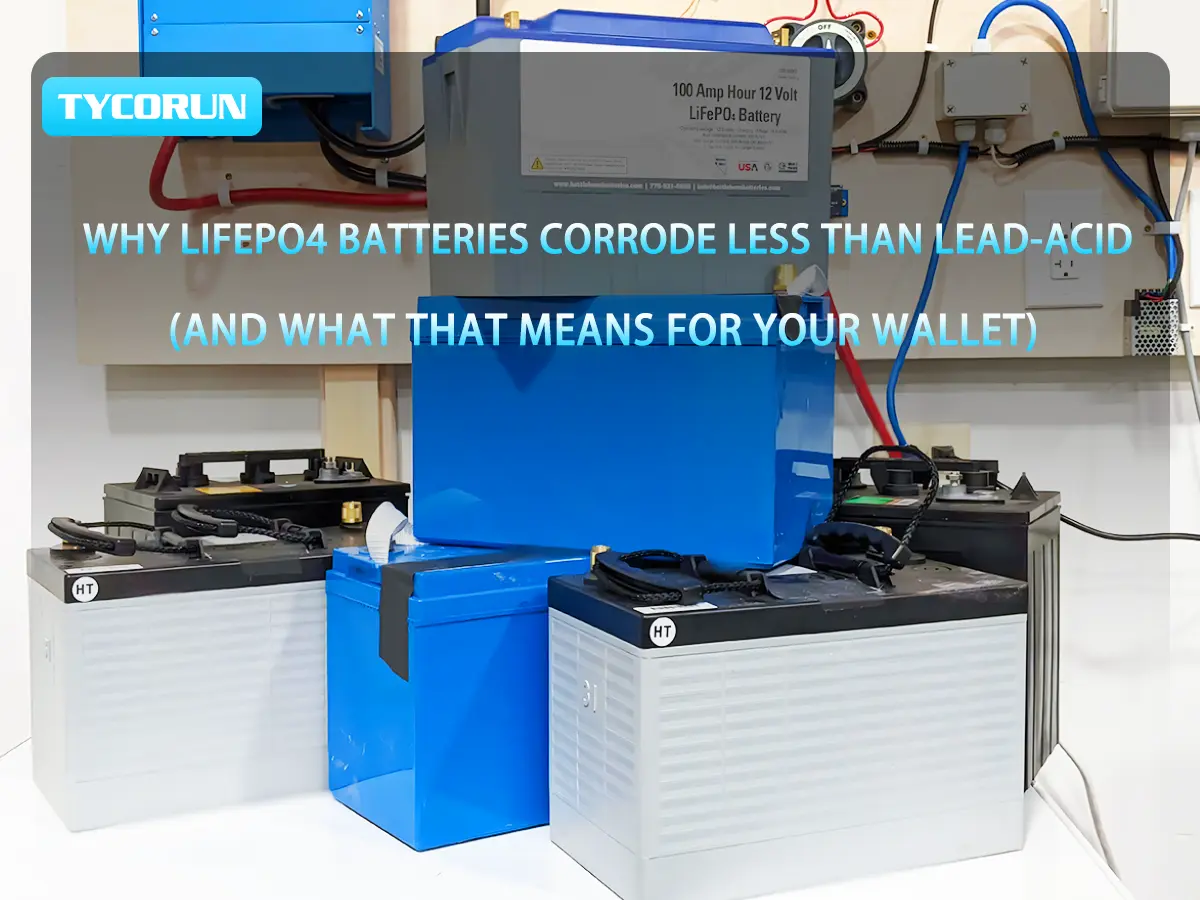
Why LiFePO4 Batteries Corrode Less Than Lead-Acid (And What That Means for Your Wallet)

Terminal corrosion is one of the most common battery maintenance problems — and one you can largely eliminate. This guide explains the chemistry behind why lead-acid batteries corrode and why LiFePO4 batteries don't, with real maintenance schedules, cost comparisons, and whether upgrading makes sense for your application.

Author :

Reviewers:

Why LiFePO4 Batteries Corrode Less Than Lead-Acid

If you’ve scrubbed the same battery terminals more than once this year, you’ve probably wondered whether there’s a battery that just doesn’t do this. There is — and the reason comes down to chemistry, not luck or maintenance habits.

This guide breaks down exactly why lead-acid batteries corrode by design, why LiFePO4 batteries largely don’t, and what that difference actually costs (or saves) you in cleaning time and money over the life of the battery. 

Quick Context: What Is Battery Terminal Corrosion?

If you’re dealing with corroded terminals and want to understand the full picture — causes, dangers, prevention, and cleaning — read our complete battery corrosion guide first. This article focuses specifically on the chemistry difference between lead-acid and LiFePO4, and what that means for your maintenance routine.
Already cleaning corroded car battery terminals? Here’s our 10-minute emergency cleaning guide for car owners.

YouTube_play_button

What Causes Battery Terminal Corrosion?

Battery terminal corrosion is a chemical reaction between three things:

  • Electrolyte vapor escaping from the battery
  • Moisture from the air
  • Metal terminals acting as the reaction surface

The result is the white, green, or blue powdery buildup you see on battery terminals — typically potassium hydroxide or copper sulfate, depending on the battery chemistry.

But not all batteries produce the same electrolyte vapor, and not all terminals are made of the same metal. This is where lead-acid and LiFePO4 diverge completely.

Lead-Acid Batteries: Why Terminal Corrosion Is Inevitable

Lead-acid batteries — the standard in most cars, boats, and backup power systems — are structurally designed to corrode. Here’s why:

Sulfuric Acid Vapor Corrosion Diagram Lead Acid Battery

Sulfuric Acid Vapor Production

During charging, lead-acid batteries electrolyze water in the electrolyte, producing:

  • Hydrogen gas (at the negative plate)
  • Oxygen gas (at the positive plate)
  • Sulfuric acid mist (carried by the gas stream)

This acid vapor escapes through vent caps, condenses on the terminals, and reacts with the lead terminal material to form lead sulfate — the white powder you scrub off.

Key point: This isn’t a defect. It’s a built-in feature of lead-acid chemistry. Every charge cycle produces some acid vapor. The harder you charge, the more vapor escapes.

Required Overcharging

Lead-acid batteries need periodic overcharging (14.4–14.8V for flooded cells) to prevent sulfation — crystal buildup on the internal plates that permanently reduces capacity.

But overcharging also:

  • Increases water electrolysis
  • Produces more acid vapor
  • Accelerates terminal corrosion

You’re caught in a trade-off: undercharge and kill the battery internally, overcharge and corrode the terminals faster.

Lead Terminal Material

Lead-acid batteries use lead alloy terminals because lead resists sulfuric acid internally. But lead oxidizes rapidly in air. Even without acid vapor, lead terminals slowly develop an oxide layer.

Combine lead + acid vapor + moisture = guaranteed corrosion, regardless of how well you maintain the battery.

Flooded Cell Design

Standard flooded lead-acid batteries have liquid electrolyte that can slosh, spill, or weep through imperfect seals. Any electrolyte contact with the terminal accelerates corrosion.

“Maintenance-free” lead-acid batteries (lead-calcium or AGM) reduce but don’t eliminate this problem. They still use sulfuric acid and lead terminals. They just seal the electrolyte better.

LiFePO4 Batteries: The Chemistry Behind Minimal Corrosion

LiFePO4 (lithium iron phosphate) batteries approach the problem from the opposite direction — eliminate the root causes rather than managing the symptoms.

Lead Acid vs LiFePO4 Terminal Corrosion Comparison

No Sulfuric Acid

LiFePO4 batteries use lithium salts dissolved in organic solvents as electrolyte — typically lithium hexafluorophosphate (LiPF₆) in a mixture of ethylene carbonate and dimethyl carbonate.

No sulfuric acid = no sulfuric acid vapor = no sulfate corrosion on terminals.

What about off-gassing? LiFePO4 batteries do produce minimal gas if severely overcharged or damaged, but this is rare and chemically different. Normal operation produces essentially no corrosive vapor.

No Required Overcharging

LiFePO4 batteries have a flat voltage curve and don’t suffer from sulfation. They charge to a fixed cutoff voltage (typically 3.6V per cell, 14.4V for a 12V pack) and stop.

An integrated Battery Management System (BMS) prevents:

  • Overcharging
  • Over-discharging
  • Cell imbalance

Result: no overcharge-induced electrolysis, no acid vapor production, no terminal corrosion from charging behavior.

LiFePO4 Battery Sealed Cell Structure Diagram

Superior Terminal Materials

LiFePO4 batteries typically use:

Terminal MaterialProperties
Nickel-plated copperExcellent conductivity, corrosion-resistant
AluminumLightweight, forms stable oxide layer (protective, not corrosive)

Neither nickel-plated copper nor aluminum reacts with atmospheric moisture the way lead does. The thin oxide layer that forms on aluminum is actually protective — it seals the surface and prevents further oxidation.

Sealed Cell Design

LiFePO4 cells are hermetically sealed with no liquid electrolyte free to move. The electrolyte is absorbed in a porous separator or gel matrix. Even if the case is compromised, the electrolyte chemistry doesn’t produce corrosive vapor under normal conditions.

Side-by-Side: Lead-Acid vs LiFePO4 Terminal Corrosion

Factor Lead-Acid LiFePO4
Electrolyte chemistry Sulfuric acid (Hâ‚‚SOâ‚„) Lithium salts in organic solvent
Acid vapor during charging Yes — every cycle No — normal operation
Required overcharging Yes — to prevent sulfation No — BMS-controlled
Terminal material Lead alloy (oxidizes in air) Nickel-plated copper or aluminum
Cell design Flooded liquid or AGM Sealed prismatic or cylindrical
Typical terminal cleaning Every 3–6 months Every 6–12 months, often never
Corrosion type when it occurs Heavy sulfate buildup, pitting Light surface oxidation, wipe-clean

Real-World Maintenance Comparison

Annual Maintenance Time

TaskLead-Acid (Annual)LiFePO4 (Annual)
Terminal inspection4 times × 5 min = 20 min1–2 times × 5 min = 10 min
Terminal cleaning2–4 times × 15 min = 60 minRarely needed
Water top-up (flooded)4–12 times × 10 min = 80 minNot applicable
Equalization charge1–2 times × 4 hours (passive)Not applicable
Total annual maintenance~3–4 hours~10 minutes

Note: AGM and gel lead-acid batteries eliminate water top-up but still require terminal cleaning and still suffer from sulfation.

5-Year Total Cost of Ownership (Example: 12V 100Ah Battery for RV/Solar)

Cost Factor Lead-Acid LiFePO4
Initial battery cost $200 $600
Battery replacements (5 years) 2× ($400 total) 0×
Terminal cleaning supplies $50 $10
Maintenance time (valued at $20/hr) $300 $20
5-Year TCO $750 $630
Illustrative example based on the stated assumptions; actual costs vary by product, region, and usage pattern. Assumptions: lead-acid lasts 2–3 years with deep cycling; LiFePO4 lasts 8–10 years. Lead-acid requires 3 hours/year maintenance; LiFePO4 requires 0.5 hours/year.
Lead Acid LiFePO4 5 Year Total Cost Ownership Chart

When Does Upgrading to LiFePO4 Make Sense?

LiFePO4 isn’t the right choice for every application. Here’s how to decide:

Strong Case for LiFePO4

ScenarioWhy It Makes Sense
Deep cycling (solar, RV, marine, off-grid)Lead-acid permanently loses capacity below 50% discharge. LiFePO4 handles 80–90% discharge daily.
Infrequent use (seasonal vehicles, backup power)Lead-acid self-discharges 5–15% per month. LiFePO4 self-discharges 2–3% per month.
Extreme temperaturesLead-acid corrosion accelerates in heat; capacity drops in cold. LiFePO4 is more stable across temperatures.
Hard-to-access installationsMarine engine compartments, rooftop solar, remote monitoring — anywhere maintenance is difficult.
High daily use (electric vehicles, commercial equipment)Lead-acid cycle life: 200–500 cycles. LiFePO4: 3,000–5,000+ cycles.

Weaker Case for LiFePO4

Scenario Consideration
Low-cost, short-term use If you need a battery for 1–2 years and minimal cycling, lead-acid is cheaper upfront.
Cold climates below -20°C LiFePO4 can’t charge below freezing without heating. Lead-acid tolerates colder charging.
Existing lead-acid systems Retrofit costs (new charger, BMS compatibility) may not justify the switch for near-end-of-life systems.

Terminal Material Matters: A Deeper Look

Not all battery terminals are the same, even within the same chemistry. Here’s what most guides don’t tell you:

Terminal MaterialCommon InMaintenance Notes
Lead alloyStandard flooded lead-acidMost prone to sulfation; baking soda cleaning every 3–6 months
Lead-calciumMaintenance-free lead-acidHarder surface, less sulfation but still needs periodic cleaning
Copper (plated)High-performance and marine batteriesUse dielectric grease instead of petroleum jelly; copper oxidizes differently
BrassAftermarket terminalsMore corrosion-resistant but can develop green patina over time
Nickel-plated copperLiFePO4 (TYCORUN and others)Minimal off-gassing means far less corrosion; clean with dry brush or damp cloth
AluminumSome LiFePO4 packsForms protective oxide layer; don’t over-torque — aluminum strips more easily

If you’re unsure what material your terminals are made of, check your battery’s specification sheet or contact the manufacturer. Using the wrong cleaning agent or torque can damage the terminal.

What About Other Lithium Chemistries?

LiFePO4 isn’t the only lithium battery type. Here’s how others compare for terminal corrosion:

ChemistryElectrolyteTerminal Corrosion RiskNotes
LiFePO4Lithium salts, organic solventVery lowSafest, most stable, longest cycle life
NMC (Nickel Manganese Cobalt)Lithium salts, organic solventVery lowHigher energy density, more thermal risk
NCA (Nickel Cobalt Aluminum)Lithium salts, organic solventVery lowHighest energy density, used in Tesla vehicles
LCO (Lithium Cobalt Oxide)Lithium salts, organic solventVery lowCommon in consumer electronics, shorter cycle life

All lithium-ion chemistries share the same advantage: no sulfuric acid, no acid vapor, no sulfate terminal corrosion. The differences are in energy density, safety, cycle life, and cost — not corrosion resistance.

FAQ: LiFePO4 and Terminal Corrosion

Rarely. When they do, it's typically minor surface oxidation rather than the heavy sulfate buildup common in lead-acid. The root cause — battery off-gassing reacting with moisture — is largely absent in lithium chemistry.

You can use baking soda solution — it's safe — but it's rarely necessary. A dry brush or lightly damp cloth is usually sufficient for light surface oxidation on LiFePO4 terminals.

Minor discoloration can occur from environmental humidity (not battery-generated vapor), galvanic reaction between dissimilar metals in the connection, or residue from previous lead-acid battery contamination in the same vehicle/system. This is typically cosmetic and doesn't affect performance.

Not entirely. You'll still need to inspect terminals annually, ensure connections remain tight, monitor BMS status if equipped, and store at proper charge level if unused long-term. But you'll eliminate terminal cleaning as a recurring task.

For most users, no — corrosion avoidance alone doesn't justify the price difference. But when you factor in 3–4× longer lifespan, 2× usable capacity (no 50% discharge limit), near-zero maintenance time, and better performance in deep-cycle applications, the total cost of ownership typically favors LiFePO4 over a 5–10 year period.

Conclusion

Terminal corrosion isn’t a maintenance failure — for lead-acid batteries, it’s a predictable byproduct of the chemistry itself. Understanding that distinction is what makes the upgrade decision straightforward: if you’re fighting recurring corrosion, cleaning better won’t fix it, but switching chemistries will.

Key takeaways:

  • Lead-acid corrosion is built into the chemistry — acid vapor, required overcharging, and lead terminals combine to make it unavoidable
  • LiFePO4 removes the root causes — no sulfuric acid, no overcharging, and corrosion-resistant terminal materials
  • The maintenance gap is significant — roughly 3–4 hours a year for lead-acid versus about 10 minutes for LiFePO4
  • Whether upgrading makes financial sense depends on your use case — deep-cycle, infrequent-use, and hard-to-access applications see the strongest returns

Need a Battery That Corrodes Less?

Tycorun LiFePO4 Battery Nickel Plated Terminal

If you’re dealing with recurring terminal corrosion, the cleaning process itself isn’t the problem — your battery chemistry is. Lead-acid batteries off-gas during charging, and that gas is the primary driver of terminal buildup.

TYCORUN’s LiFePO4 batteries are designed for electric vehicles, energy storage systems, and industrial applications where reliability and low maintenance matter. If you’re evaluating whether a lithium upgrade makes sense for your application, our team can help you assess compatibility and expected performance.

Related Post
What Happens If You Drop a Lithium Battery Safety Risks Explained
What Happens If You Drop a Lithium Battery: Safety Risks Explained

In this article, you’ll learn about lithium batteries, answering what happens if you drop a lithium battery, risks of lithium battery dropped, impact on battery performance, signs of a damaged lithium battery, how to handle a dropped lithium battery safely and real-life examples.

Authors

  • Ryder

    Ryder is a hands-on lithium battery specialist and technical content author with over five years of deep field experience in electric mobility infrastructure. He specializes in cell testing, pack diagnostics, and real-world Battery Management System (BMS) performance analysis. Having collaborated closely with top-tier R&D teams, Ryder excels at evaluating battery safety against stringent global standards like UN38.3 and IEC 62133. Through his articles, he aims to eliminate marketing noise, offering readers raw, data-driven insights into battery safety, performance, and lifespan optimization.

    View all posts
  • Meg

    Meg is a battery engineer with 10+ years of experience in the energy storage industry. She holds a B.S. in Electrical Engineering and previously worked as an R&D engineer at a lithium-ion battery manufacturer, where she focused on battery management systems (BMS), charging algorithms, and life-cycle testing for lead-acid, AGM, and lithium chemistries. She has contributed to the development of battery maintenance technologies used in commercial products. Meg now provides technical review for energy storage content to ensure accuracy, safety, and practical value for readers.

    View all posts
Table of Contents
    Add a header to begin generating the table of contents

    You Might Also Like...

    How to Convert Amp Hours to Watt Hours (Ah to Wh Calculator and Chart)

    How to Convert Amp Hours to Watt Hours (Ah to Wh Calculator and Chart)

    Convert amp hours to watt hours with one formula: Wh = Ah × V. This guide gives you a calculator, lookup charts from 12V to ...
    Lithium Battery for RV Off-Grid Sizing and Cold Charging

    Lithium Battery for RV: Off-Grid Sizing and Cold Charging

    Planning an off-grid RV trip or camping in winter? Find out how much battery capacity you need, how to match it to your appliances, and ...
    Ganfeng Begins 588Ah Storage Cell Ramp; 648Ah Planned for 2027

    Ganfeng Ramps 588Ah Storage Cells, 648Ah Due 2027

    Ganfeng LiEnergy has moved its 588Ah storage cell line into production ramp and scheduled a 648Ah cell for 2027. This article converts the new formats ...
    EU Battery Passport 2027 Requirements for LMT and Energy Storage Batteries

    EU Battery Passport 2027: Requirements for LMT and Energy Storage Batteries

    From 18 February 2027, LMT batteries, EV batteries and industrial batteries above 2 kWh need an EU battery passport. See what the record contains, who ...
    EU Battery Regulation 20231542 What Battery Buyers Need to Know

    EU Battery Regulation 2023/1542: What Battery Buyers Need to Know

    A buyer’s breakdown of Regulation (EU) 2023/1542 for e-mobility and stationary storage. Learn how LMT and industrial batteries are classified, what applies from CE marking ...
    Lithium Battery vs Lithium-Ion Battery What’s the Real Difference

    Lithium Battery vs Lithium-Ion Battery: What’s the Real Difference?

    Lithium vs lithium-ion mostly comes down to single-use versus rechargeable. Here is how to read the label, compare voltage and shelf life, and pick the ...