Planning a weekend trip with an RV is fun until you realize your battery has died in the middle of the journey. Therefore, choosing the right battery size is not just a matter of convenience, but also ensures a smooth and stress-free trip wherever you go.
In this article, we will discuss what size battery do I need for my RV? so that the battery can last throughout the weekend without needing to be recharged.
Why Battery Size Matters for Every RV Owner
Choosing an RV battery is not simply a matter of “the bigger, the better”. The right battery size is crucial because it affects durability and efficiency throughout the trip. You can have a large battery, but if your electricity consumption is higher than the battery capacity, you will still run out of power. Conversely, a battery that is too large can be wasteful in terms of cost, weight, and space.
Electricity needs in RVs vary greatly: LED lights, refrigerators, water pumps, fans, gadget chargers, and cooking equipment. Each device draws a certain amount of current for example, a fan can draw 2A per hour, a light 1A, and a refrigerator can draw 5 to 8A depending on its size and efficiency. If the battery is too small, you may have to turn off some devices so that you do not run out of power at night.
By knowing the answer to the question what size battery do I need for my RV?, you can plan the appropriate capacity between the electrical load and the duration of use. When you calculate your estimated power requirements for 2 to 3 days, you can answer the question of what size battery do I need for my RV? with more confidence. Having a battery with sufficient capacity helps avoid sudden power failures, maintaining comfort during your weekend getaway.
Understanding Battery Basics: Capacity, Voltage, and Amp-Hours
RV batteries are not only about physical size. What really determines performance are battery capacity, battery voltage, as well as amp-hours.
To answer the question of what size battery do I need for my RV?, you need to understand how batteries store energy, how RV electrical systems work, and how to calculate daily device consumption. Without this basic understanding, it is easy to choose a battery that is too small which results in power depletion or too large which is wasting space, weight, and money.
What Is Battery Capacity (Ah) and Why Does It Matter?
Battery capacity is generally measured in amp-hours (Ah) which shows the amount of current (amperes) that can be supplied for one hour. For example, a 100 Ah battery can provide 1 A for 100 hours or 10 A for 10 hours (ideal). When you calculate which size of battery you need for your RV, you must add up the total daily current requirements (in Ah) of all electrical devices in the RV. Of course, allow for a margin of error so that the battery does not drop to a very low level.
The Role of Voltage in RV Power Systems
Most RV electrical systems use 12 volts DC as the standard voltage, to be compatible with many DC electrical devices and systems. This voltage is important because when you choose a battery, you must ensure that the battery, inverter, and charging system are all compatible with that voltage. If you use a different voltage, the ampere-hour calculation formula will also be different.
How to Estimate Power Usage for Your RV
To estimate your daily power needs and determine what size battery you need for your RV, the first step is to calculate the total energy consumption of all the devices you use.
Each device has a power rating (in watts) and daily usage time (hours). For example, a 10-watt LED light used for 5 hours consumes 50 watt-hours (Wh), an 80-watt refrigerator used for 8 hours consumes 640 Wh, and a 50-watt TV used for 3 hours consumes approximately 150 Wh.
After calculating the total Wh, divide that number by 12 V (standard RV system voltage) to get the daily amp-hour (Ah) requirement. If the total is around 120 Ah per day, then for a weekend trip (two days) you need at least a 240 Ah battery, plus a reserve margin of about 20 to 30%. Learn more in our article on battery voltage.
Using this method, you can accurately answer the question what size battery do I need for my RV?” based on actual usage patterns.
How to Calculate What Size Battery You Need for a Weekend Trip
Determining what size battery you need for your RV to last throughout the weekend is actually quite simple if you take the right approach. The first step is to calculate the total daily energy consumption of all electrical devices in the RV, such as lights, refrigerators, TVs, fans, and chargers. Each device has a power rating (Watts) and duration of use (hours). Multiply the two to get the energy requirement in watt-hours (Wh) per day, then add up all the results.
The second step is to multiply the total Wh by the number of days of travel. For example, if your RV’s total power requirement is around 1,200 Wh per day, and the trip lasts 2 days, then the total energy required is 2,400 Wh.
Step three, convert the Wh to ampere-hours (Ah) according to the battery system voltage. Since most RVs use a 12V system, 2,400 Wh ÷ 12V = 200 Ah. However, to maintain a safe power reserve and avoid draining the battery completely, it is recommended to add about 30 to 40%. Therefore, the ideal total capacity is around 300Ah for a weekend. With this calculation, you can confidently answer the question of what size battery do I need for my RV so that you don’t run out of power during your trip.
Comparing Different Battery Types for RV Use
Knowing the answer to the question of what size battery do I need for my RV? is not enough. You also have to consider the type of battery that best suits your RV’s usage style and conditions.
Different types of batteries affect efficiency, lifespan, weight, and the ability to be drained during travel. Let’s look at the advantages and disadvantages of each type of battery so that we can choose the right battery size while taking the type into consideration.
Lead-Acid Batteries
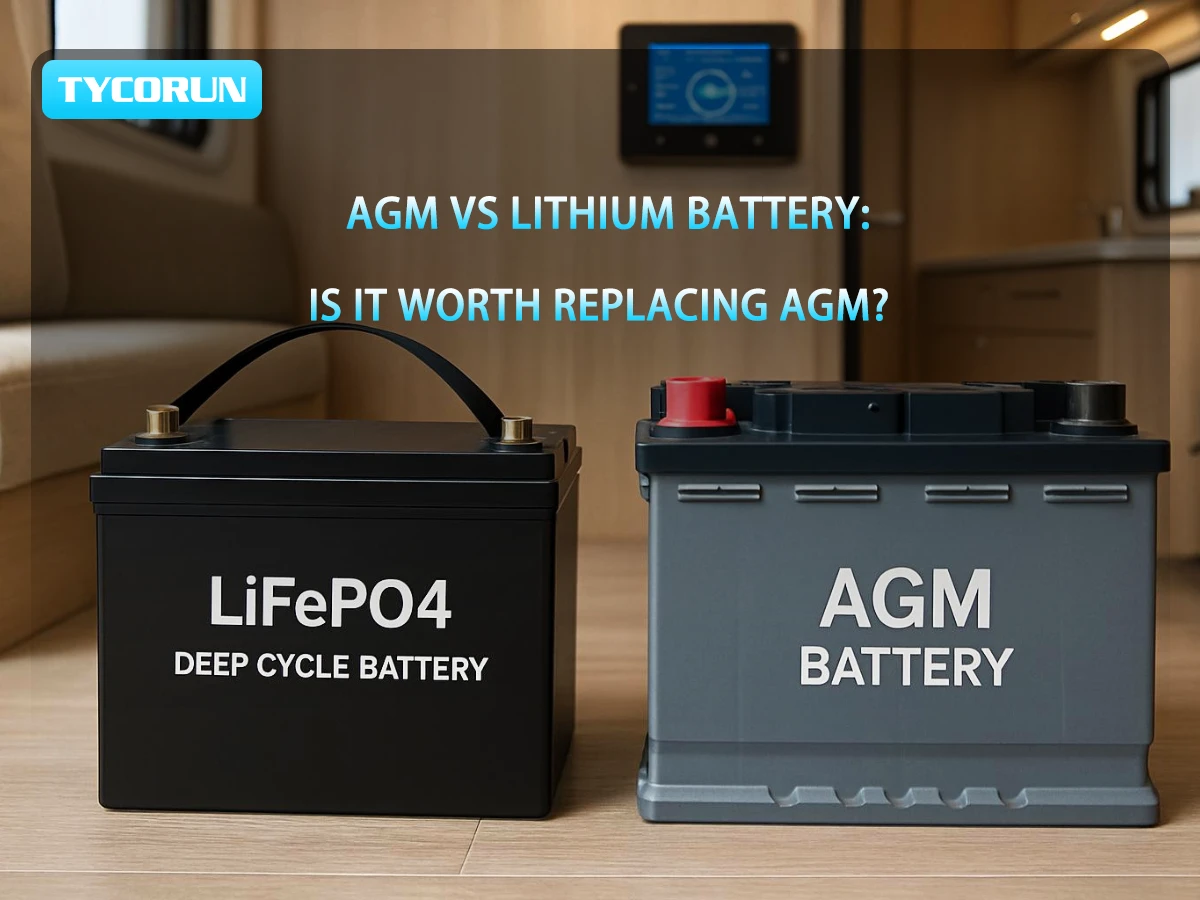
Traditional lead-acid batteries (including flooded models) and AGM (Absorbent Glass Mat) versions are often used because their initial cost is relatively low and their components are easy to find. However, they have disadvantages such as being heavier and not being able to be discharged to 100% without damaging the battery cycle. For example, conventional lead-acid batteries should only be used up to 50% of their capacity to maintain a good service life. In the context of what size battery do I need for my RV, if you use a lead-acid battery, you must choose a much larger capacity to provide a safety margin.Explore more about this on our dedicated post on how does lead acid battery work.
Lithium-Ion Batteries
Lithium-ion batteries, especially the LiFePO₄ type, offer significant advantages. They are lighter, highly efficient, and can be discharged to 80 to 90% without damaging the battery. With greater power per capacity, you can choose a smaller battery that still lasts long enough. Additional advantages, this type of battery has a longer life cycle and fast charging capability.
Gel Batteries
Gel batteries are a variant of lead-acid batteries that use gel electrolytes. They are suitable for moderate use and require less maintenance. However, their high current capacity and discharge efficiency are generally lower than AGM or lithium. For owners who rarely use a lot of electrical loads continuously, gel batteries can be a middle-of-the-road option. But remember, when calculating the battery size, additional capacity is still needed to ensure sufficient power for weekend trips. You might also find our article on what is an agm battery helpful.
Battery Size for Different RV Setups
Knowing the answer to the question of what size battery do I need for my RV? is very important because each type of RV has different power requirements depending on its size, electrical load, and length of travel without an external power source. The larger the RV, the greater the battery capacity required to ensure that all devices can function without interruption during weekend trips.
Small Camper or Pop-Up RV
For small or pop-up RVs, a capacity of 100Ah to 150Ah is generally sufficient. These types only require power for lights, fans, and cell phone charging. Since power consumption is relatively low, owners can simply add a simple charging system such as a small solar panel. By calculating these basic needs, you can answer the question of what size battery do I need for my RV? more accurately without having to invest in excess capacity.
Mid-Size Travel Trailer
For medium-sized trailers, it is recommended to use a 200Ah to 300Ah battery because the electrical load usually includes a refrigerator, water pump, and entertainment equipment. This system is suitable for users who want to camp for 2 to 3 days without recharging. Knowing these details will help you balance capacity, weight, and efficiency.
Large Motorhome or Full-Time RV
For large motorhomes or full-time RV users, a minimum of 400Ah to 600Ah is required. Lithium types are more recommended due to their high efficiency and lighter weight. With this capacity, you can enjoy all the amenities such as air conditioning, microwave, and large refrigerator without fear of running out of power. Lithium solutions are the best choice for durability and optimal performance.
How Long Can an RV Battery Last Without Recharging?
The length of time an RV battery can last without recharging depends on several key factors: battery capacity, battery type, number of active devices, and weather and environmental conditions. A battery with a large capacity will certainly last longer, but if there are many active devices such as lights, refrigerators, water pumps, and inverters, the power will be drained quickly. The type of battery also has an impact. For example, lithium (LiFePO₄) batteries can be drained more deeply than traditional lead-acid batteries. In addition, extreme temperatures accelerate battery degradation and efficiency loss.
As a practical guide, many sources say that a standard 12 V battery for RV applications can last one to two days with normal use during travel without an external power source. Other sources indicate that a medium-capacity dual battery system may last less than a day under high load conditions.
With an understanding of what size battery do I need for my RV?, you can calculate the estimated real-world duration based on your electrical load and select a battery that can cover those needs.
Tips to Make Your RV Battery Last Longer During Weekend Trips
To ensure your RV battery lasts throughout the weekend, it is not enough to just choose the right battery size; it is also important to implement good efficiency and maintenance strategies.
Limit Unnecessary Power Consumption
Turn off unused devices, such as extra lights, standby electronic devices, or entertainment systems when they are not needed.
Use LED Lights and Energy-Efficient Appliances
Replace conventional lights with LEDs and use appliances with low consumption ratings. These small changes are significant in reducing daily power expenditure, making your battery feel more powerful.
Add Solar Panels or a Generator Backup
Adding solar panels or a generator as a backup helps keep the battery charged during your trip. When the battery is low, these additional systems can add power without having to rely too much on the main battery capacity.
Conclusion
Determining what size battery do I need for my RV is an important step to ensure a comfortable weekend trip free from power interruptions. By understanding the capacity, type, and daily energy requirements, you can choose the right battery for your camping lifestyle.
Frequently asked questions
Check whether the battery can last at least 2 to 3 days without recharging. If it often runs out of power, its capacity may be too small for your needs.
Yes, you can connect two batteries in parallel to increase the ampere-hour capacity, as long as they are of the same type and age.
Definitely. Although more expensive, lithium batteries are lighter, longer lasting, and more efficient, they are ideal for answering the question of what size battery do I need for my RV with maximum performance.
Who We Are
With over 17 years of experience, TYCORUN is a leading lithium battery supplier committed to driving innovation and development of battery technology. Our diverse product range includes two/three/four-wheeled power batteries, energy storage systems, one stop battery swap systems, inverters, and electric motorcycles. These high-quality solutions are trusted in Europe, the Middle East, and Africa.
We provide customized battery services, from cells to complete systems, and holds certifications like ISO9001, CE, TUV, and UL. TYCORUN has developed solid-state batteries for better performance and uses advanced BMS algorithms for safety and longer life.
TYCORUN’s global reach is strengthened through our strategic partnership with Ganfeng, a top-five Chinese battery manufacturer. This collaboration offers us professional technology and production support. We fully manage Ganfeng’s overseas battery business and have collaborated to mass sell swappable, power, and energy storage batteries to Thailand, Dubai, Egypt, South Africa, Saudi Arabia, etc.

This article will cover what is maintenance-free battery and maintainable battery, the specific difference between these batteries, the 3 types of maintenance free battery, its advantages and limitations, and applications of 3 types of maintenance free battery. Let’s dive in!

In this article, we’ll explore in detail how long do AGM batteries last, starting from the factors that affect it, its average lifespan, tips on maximizing lifespan, to signs that the battery needs to be replaced.

This article will explain what battery depletion is, the signs to watch out for, common causes, and solutions to address it so you know when it’s time to replace your battery.
Authors
-
View all postsWith over five years of experience in writing, I have honed my skills in crafting compelling content across various topics. Currently, I am deeply interested in exploring the intersections of technology, sustainability, and renewable energy. My passion lies in understanding how these fields shape the future and communicating complex ideas in a way that is both engaging and accessible. Through my writing, I aim to bridge the gap between innovation and awareness, inspiring others to embrace sustainable solutions for a better world.
-
View all postsMeg is a battery engineer with 10+ years of experience in the energy storage industry. She holds a B.S. in Electrical Engineering and previously worked as an R&D engineer at a lithium-ion battery manufacturer, where she focused on battery management systems (BMS), charging algorithms, and life-cycle testing for lead-acid, AGM, and lithium chemistries. She has contributed to the development of battery maintenance technologies used in commercial products. Meg now provides technical review for energy storage content to ensure accuracy, safety, and practical value for readers.