 Skip to content



Last Updated on July 9, 2026
A battery cell is the fundamental electrochemical unit that stores chemical energy and converts it into electrical energy through a controlled reaction. It is the smallest building block of any battery system—whether in your smartphone, electric vehicle, or grid-scale energy storage. Understanding how a battery cell works, its components, and its characteristics is essential for anyone evaluating energy storage solutions in 2026.
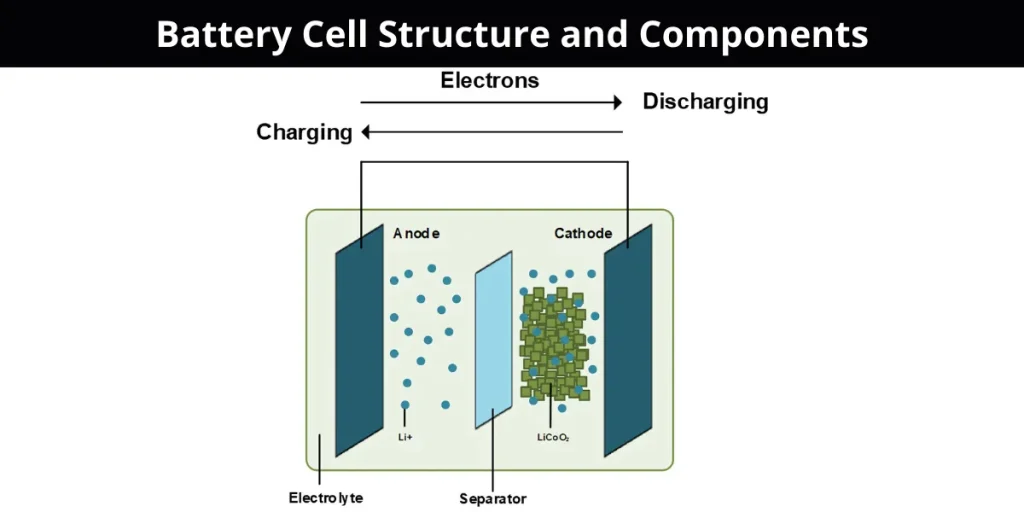
A battery cell is a single electrochemical unit containing an anode, cathode, electrolyte, and separator that produces electrical energy through ion movement. Multiple cells are combined to form battery modules and packs.


How Does a Battery Cell Work?
A battery cell operates on electrochemical principles. During discharge:
- Oxidation occurs at the anode (negative electrode), releasing electrons
- Electrons flow through the external circuit, powering the device
- Reduction occurs at the cathode (positive electrode), accepting electrons
- Ions move through the electrolyte to maintain charge balance
During charging, this process reverses: external electrical energy drives ions back to the anode, restoring the cell’s chemical potential.
Key Insight: The voltage of a single battery cell is determined by its chemistry. For example, a lithium-ion cell typically delivers 3.2–3.7V, while a lead-acid cell delivers around 2.0V. This is one reason EV battery packs connect hundreds of cells in series to reach system voltages in the 400V–800V range.
Battery Cell Structure and Components
Every battery cell contains four critical components:
Anode (Negative Electrode)
- Function: Source of electrons during discharge; stores lithium ions during charge
- Common materials: Graphite, silicon (emerging), lithium metal (next-generation)
- 2026 trend: Silicon-graphite composite anodes are gaining traction in commercial cells. Silicon has a much higher theoretical (material-level) lithium storage capacity than graphite, but at the full-cell level today’s silicon-composite anodes typically deliver a meaningful — not order-of-magnitude — improvement over pure graphite, since practical designs must limit silicon content to manage expansion and degradation.
Cathode (Positive Electrode)
- Function: Electron receiver during discharge; source of lithium ions during charge
- Common materials:
- LCO (Lithium Cobalt Oxide) — smartphones
- NMC (Nickel Manganese Cobalt) — EVs
- LFP (Lithium Iron Phosphate) — energy storage, budget EVs
- NCA (Nickel Cobalt Aluminum) — high-performance EVs
Electrolyte
- Function: Medium for ion transport between electrodes
- Types:
- Liquid electrolyte — most common in Li-ion cells today
- Gel polymer — used in some consumer electronics
- Solid-state — an emerging technology still in development/early piloting (see below)
Separator
- Function: Physical barrier preventing direct contact between anode and cathode (which would cause a short circuit)
- Material: Typically microporous polypropylene or polyethylene
- Critical spec: Must allow ion passage while blocking electron flow
Types of Battery Cells
Battery cells are broadly categorized by rechargeability and chemistry.
Primary (Non-Rechargeable) Cells
| Type | Typical Voltage | Common Uses | Key Characteristic |
|---|---|---|---|
| Alkaline | 1.5V | Remote controls, flashlights | Low cost, widely available |
| Lithium Primary (Li-MnO₂) | 3.0V | Medical devices, sensors | High energy density, long shelf life |
| Zinc-Air | 1.4V | Hearing aids | High energy density, activated by air |
Secondary (Rechargeable) Cells
| Chemistry | Nominal Voltage | Typical Energy Density (Wh/kg) | Typical Cycle Life | Primary Application |
|---|---|---|---|---|
| Lithium-ion (NMC) | 3.6–3.7V | ~200–280 | ~1,000–2,000 | Electric vehicles |
| Lithium-ion (LFP) | 3.2V | ~140–160 | ~3,000–6,000 | Energy storage, commercial EVs |
| Nickel-Metal Hydride (NiMH) | 1.2V | ~60–120 | ~500–1,000 | Hybrid vehicles, power tools |
| Lead-Acid | 2.0V | ~30–50 | ~200–500 | Automotive starter, backup power |
| Sodium-ion | ~3.0V | ~100–160 | ~2,000–4,000 (emerging data) | Grid storage (early-stage adoption) |
Note: Energy density and cycle life figures above reflect commonly cited industry ranges rather than any single manufacturer’s spec sheet. Actual performance varies significantly by cell design, manufacturer, and testing conditions — always confirm against a specific datasheet before making sourcing decisions. For a peer-reviewed breakdown of chemistry-level trade-offs, see the NREL grid-scale storage technology report.
Battery Cell vs. Battery Pack: What's the Difference?
| Feature | Battery Cell | Battery Module | Battery Pack |
|---|---|---|---|
| Definition | Single electrochemical unit | Multiple cells connected | Multiple modules + BMS + casing |
| Voltage | 1.2V–3.7V (typical) | 12V–48V | 48V–800V+ |
| Example | 18650 cylindrical cell | Several cells in series | EV battery pack |
| Management | None | Basic balancing | Full BMS, thermal management |
Illustrative example: Large-format EV battery packs, such as those used in mass-market Tesla models, are commonly reported to contain thousands of small cylindrical cells (in the 2170 or, more recently, 4680 format) arranged across multiple modules — the exact count varies by model, trim, and battery option, and manufacturers do not always publish precise figures. A Battery Management System (BMS) monitors each cell or group of cells for voltage and temperature to help prevent overcharging, overheating, and imbalance. Cell and pack safety requirements in most major markets are governed by standards such as IEC 62133 for portable cells and UN 38.3 for transport.
Key Battery Cell Characteristics

When evaluating battery cells for any application, these parameters matter:
- Energy Density (Wh/kg or Wh/L)
Measures how much energy a cell can store per unit weight or volume. Higher-nickel NMC chemistries generally lead on energy density among commercial Li-ion cells today, though exact figures vary by manufacturer and generation. Higher energy density often trades off against cycle life and safety margin.
- Power Density (W/kg)
Measures how quickly a cell can deliver energy — critical for EV acceleration and fast charging. LFP cells generally have lower energy density but comparable or better power density than NMC in many designs.
- Cycle Life
Number of charge/discharge cycles before capacity drops to roughly 80% of original. LFP chemistries typically outlast NMC in cycle count, which is a major reason they’re favored for stationary energy storage.
- C-Rate (Charge/Discharge Rate)
1C means a full charge or discharge in 1 hour. Some modern EV cells are designed to support fast charging in the range of several C, enabling faster charge times — but sustained high C-rates generate more heat and can accelerate degradation.
- Operating Temperature Range
Standard Li-ion cells are typically rated for roughly -20°C to 60°C, though this varies by chemistry and cell design. Extreme environments often require specialized chemistries or active thermal management.
Battery Cell Applications in 2026
Battery cells power virtually every aspect of modern life. Demand continues to grow rapidly across several sectors:
| Sector | Adoption Trend (2026) | Typical Cell Type | Key Trend |
|---|---|---|---|
| Consumer Electronics | Mature, steady demand | LCO, NMC | Thinner cells, faster charging |
| Electric Vehicles | Rapidly growing | NMC, LFP | Higher-voltage architectures, cell-to-pack designs |
| Energy Storage | Rapidly growing | LFP, sodium-ion (early stage) | Longer-duration storage, grid-scale projects |
| Medical Devices | Steady, specialized demand | Li-primary, Li-ion | Implantable, long-life requirements |
| Aerospace/Defense | Niche, specialized demand | Specialized Li-ion | Extreme temperature tolerance |
Market-size figures are intentionally omitted here, as reliable, consistently sourced 2026 figures vary widely across research firms. Readers needing precise market-sizing data should consult a named industry report directly.
Latest Innovations: Solid-State and Beyond
Solid-State Battery Cells
- What changes: Liquid electrolyte replaced by a solid ceramic or polymer electrolyte
- Potential benefits: Higher energy density, improved safety, wider temperature tolerance — based on prototype and pilot-scale results reported by developers
- Status: Several major battery and automotive companies have announced pilot lines and are targeting commercialization later in the decade; timelines have historically slipped and should be treated as directional rather than firm. As of early 2026, Samsung SDI, Toyota, QuantumScape, and Solid Power all operate pilot-scale lines, with most public roadmaps pointing to small-batch production around 2027–2028 and broader mass production around 2030 (IDTechEx research summary).
- Challenge: Manufacturing scalability and cost remain significant barriers to mass production
Sodium-Ion Cells
- Why it matters: Sodium is abundant and inexpensive relative to lithium
- Performance: Generally lower energy density than lithium-ion, but competitive cycle life and good safety characteristics
- 2026 status: Several major battery manufacturers have begun limited commercialization of sodium-ion cells for grid storage and entry-level EV applications; broader adoption is still in early stages. CATL, for instance, announced plans in late 2025 to expand sodium-ion deployment across battery-swap, passenger-vehicle, and energy-storage applications through 2026 (Charged EVs coverage).
Silicon Anode Technology
- Advantage: Silicon has a much higher theoretical lithium storage capacity than graphite at the material level
- Challenge: Silicon expands significantly during charging (often cited around 300%), which can cause mechanical degradation over repeated cycles
- 2026 status: Silicon-graphite composite anodes (silicon as a minority additive) are entering mass production in some consumer and EV cells, delivering meaningful but not order-of-magnitude gains over pure graphite at the full-cell level
Frequently Asked Questions (FAQs)
A battery cell is a single electrochemical unit. A battery (or battery pack) is multiple cells connected together with management electronics, thermal systems, and protective casing.
Cycle life varies by chemistry: LFP cells are typically rated for several thousand cycles, NMC cells for roughly one to two thousand, and lead-acid cells for a few hundred. Calendar life is typically 5–15 years depending on usage patterns and temperature, though this varies by application.
Lithium-ion remains dominant overall, with LFP gaining significant share in energy storage and commercial EVs due to its safety and longevity, while NMC remains common in passenger EVs prioritizing maximum range.
Yes. Lithium-ion cell recycling capacity has been expanding, with several specialized recyclers reporting high recovery rates for lithium, cobalt, and nickel from end-of-life cells.
For example, Redwood Materials states it recovers more than 95% of critical materials such as lithium, nickel, cobalt, and copper from end-of-life batteries. Regulatory requirements around minimum recycling rates are also expanding in various regions, including the EU. Readers seeking exact current recovery-rate figures should check the recycler's own published data, as these figures are updated periodically.
These are cylindrical cell formats named by their approximate dimensions (18mm diameter × 65mm length for 18650; 21mm × 70mm for 2170). The newer 4680 format (46mm × 80mm) has been entering production for some EV applications, aimed at improving energy density and manufacturing efficiency.
Conclusion
A battery cell is far more than a simple energy container—it is a precisely engineered electrochemical system whose components, chemistry, and design determine the performance of everything from smartphones to grid-scale storage. The industry continues to move toward solid-state technology, sodium-ion alternatives, and higher-voltage architectures, though the pace of that transition varies by application and should be tracked against primary sources rather than assumed.
Whether you are selecting cells for a product design, evaluating energy storage investments, or simply seeking to understand the technology powering the electrification revolution, a solid grasp of battery cell fundamentals is essential.
If you’re evaluating LFP cells for an energy storage or EV project, TYCORUN’s LiFePO4 cell manufacturing page covers our production standards and customization options in more detail.
Sources & Further Reading
- National Renewable Energy Laboratory (NREL) — Grid-Scale Battery Storage: Frequently Asked Questions
- Redwood Materials — Critical Materials Recovery Data
- IDTechEx — Solid-State Battery Commercialization: Mass Production Taking Off
- Charged EVs — CATL to Deploy Sodium-Ion EV Batteries at Commercial Scale in 2026
- International Electrotechnical Commission (IEC) — IEC 62133 Portable Cell Safety Standard
This article is reviewed periodically to reflect current industry data. Figures without a linked source above represent commonly cited industry ranges and should be verified against a specific manufacturer’s datasheet before use in technical or purchasing decisions.
Authors
-
 View all posts
Anastasia is a dedicated renewable energy researcher and technical writer specializing in inverters, home energy storage solutions, and clean energy trends. With a sharp eye for market analysis and industry shifts, she transforms complex technical concepts into actionable, easy-to-understand insights. Her goal is to empower homeowners and businesses alike to make highly informed decisions regarding sustainable energy deployment.
-
 View all posts
Meg is a battery engineer with 10+ years of experience in the energy storage industry. She holds a B.S. in Electrical Engineering and previously worked as an R&D engineer at a lithium-ion battery manufacturer, where she focused on battery management systems (BMS), charging algorithms, and life-cycle testing for lead-acid, AGM, and lithium chemistries. She has contributed to the development of battery maintenance technologies used in commercial products. Meg now provides technical review for energy storage content to ensure accuracy, safety, and practical value for readers.





