

Disclaimer: This article is for informational purposes only and does not constitute medical advice. In case of suspected battery ingestion, immediately contact your local poison control center or emergency services. Always follow the instructions of healthcare professionals.
If a button or coin battery may have been swallowed, call Poison Control immediately — 1-800-222-1222 (U.S. only) — or National Battery Ingestion Hotline: 1-800-498-8666 (U.S. only) even if there are no symptoms. If you are outside the United States, contact your local poison control center or national emergency number immediately instead — search “poison control [your country]” if you don’t have the number saved, or call your local emergency services line (e.g., 999 in the UK, 000 in Australia, 112 in the EU). Call 911 (or your local emergency number outside the U.S.) if there is choking, difficulty breathing, or severe symptoms. Damage can begin rapidly—sometimes within minutes—and may cause severe injury within about 2 hours when lodged in the esophagus.
A standard AA, AAA, or 9V battery, if it was whole and undamaged, generally carries much lower risk and often passes through the digestive system without serious harm— but still call Poison Control to confirm before assuming it’s fine.
This guide explains what to do immediately, why battery type changes everything, what happens during medical evaluation, and how to prevent this in your home.
Key Takeaways:
- Button or coin battery ingestion requires immediate contact with Poison Control (U.S.) or your local poison control/emergency service (outside the U.S.) because rapid chemical injury can begin within minutes and escalate within hours.
- Button batteries cause esophageal damage through electrical current that generates caustic reactions in moist tissue, making “no symptoms” an unsafe indicator.
- Battery type determines risk level, where cylindrical AA, AAA, 9V, C, and D batteries generally present lower danger when intact compared to button batteries.
- Emergency response for suspected battery ingestion depends on immediate triage guidance, with the relevant poison control or emergency service directing whether urgent hospital care or monitored observation is required.
What Should I Do Right Now?
- As mentioned earlier, call Poison Control (1-800-222-1222, U.S. only) or the National Battery Ingestion Hotline (1-800-498-8666, U.S. only) immediately, even if the person seems completely fine. If you’re outside the U.S., call your local poison control center or emergency number instead — don’t dial the U.S. numbers above, as they will not connect.
- If it was a button or coin battery and the person is over 12 months old and can swallow safely, you will be advised to give a small amount of honey on the way to care. Don’t do this without guidance, and never with a child under 12 months old — this is explained fully below.
- Don’t wait to see if symptoms develop. Damage from a button battery can start before any pain is felt.
- Don’t try to make the person vomit.
- Get to an emergency department right away if you’re told to, or if there’s any difficulty breathing, swallowing, or severe pain.
If the battery was a standard AA, AAA, or 9V battery, intact and undamaged, the immediate danger is generally much lower. Still make the call — your local poison control service can confirm this based on what was swallowed and help you decide whether to just monitor at home.
Is This Actually an Emergency? Why Battery Type Matters
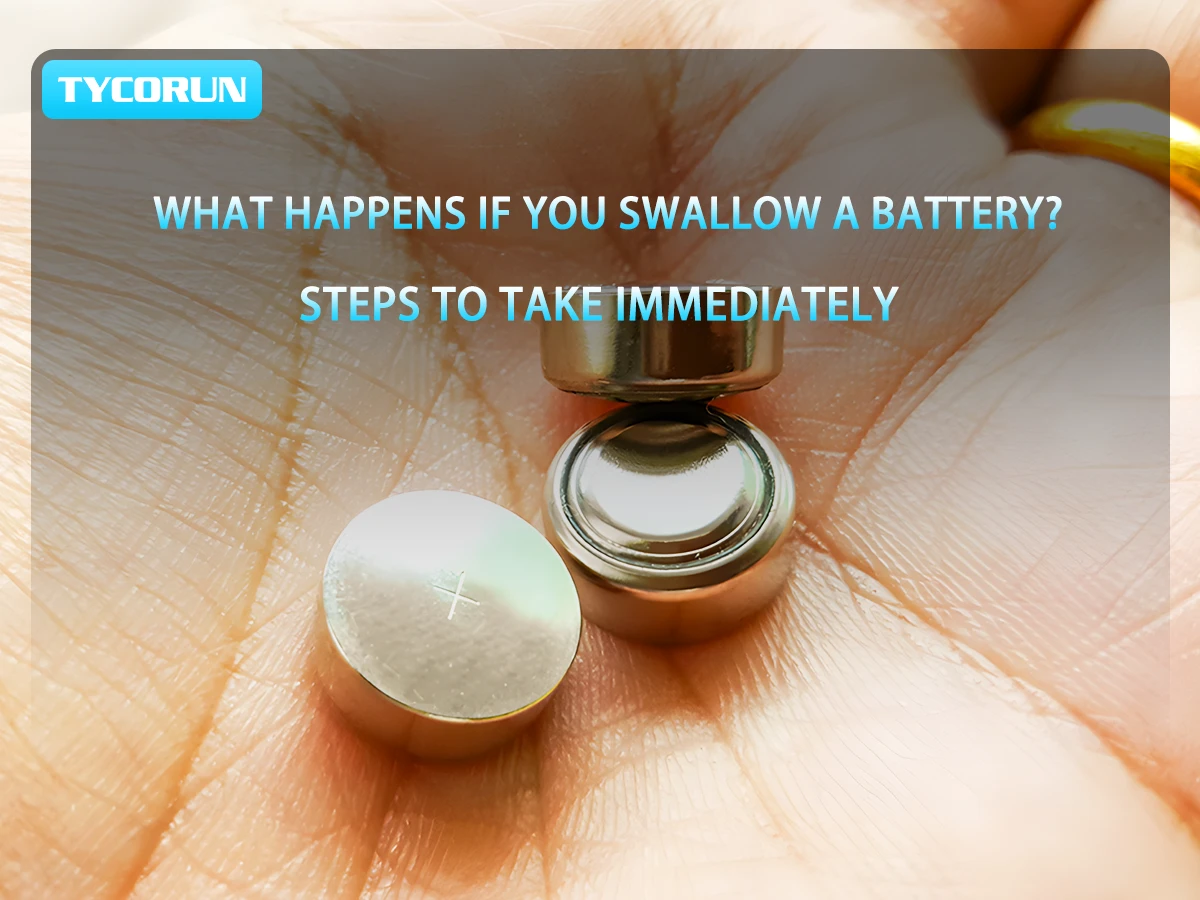
Button or coin batteries are small, round, and flat — the kind found in remote controls, key fobs, talking greeting cards, hearing aids, watches, and small toys. These are the highest-risk category, particularly larger lithium coin cells. You can often identify the most dangerous size by the code printed on the battery itself: CR2032, CR2025, and CR2016 are common markings for the 20mm lithium cells responsible for most severe ingestion cases.
Cylindrical batteries — AA, AAA, 9V, C, and D — are generally much lower risk if swallowed whole and intact. They usually pass through the digestive tract without causing serious harm. The risk changes significantly if the casing is cracked, bitten into, or already leaking, which is covered in its own section below.
Why Are Button Batteries So Dangerous?
This isn’t primarily a choking or blockage problem — it’s a chemical burn problem. When a button battery comes into contact with the moist tissue of the throat or esophagus, it generates a small electrical current. That current triggers a chemical reaction that produces a caustic substance capable of burning through tissue. Tissue injury can begin rapidly after ingestion, and severe, potentially life-threatening damage may occur within hours if the battery becomes lodged in the esophagus, according to findings reported by Litovitz et al. (2010).
This is different from most other things a child might accidentally swallow, where the main risk is choking or an object getting physically stuck. With a button battery, active tissue damage can be happening even while the battery sits still.
What If There Are No Symptoms? (This Is the Part Most People Get Wrong)
The absence of symptoms in the first hours does not mean it’s safe to wait. According to the National Capital Poison Center’s Button Battery Ingestion Triage and Treatment Guideline, fatalities and severe esophageal or airway burns have occurred even in cases where the person initially had no symptoms at all after swallowing the battery.
This happens because the chemical injury can begin at a tissue level before pain signals or visible symptoms show up. A child who seems completely normal can still have significant internal damage already underway. This is why immediate contact with the relevant poison control service is recommended, even when the person appears completely well.
The Honey Protocol — When It Helps and When It Doesn't
Current medical guidance from poison control centers (this protocol reflects U.S. guidance; confirm with your local poison control service if outside the U.S., as recommendations may differ) recommends that, for children over 12 months old who have swallowed a button battery and can still swallow safely, giving a small amount of honey by mouth on the way to care may help. The honey coats the esophagus and the battery itself, which can reduce the severity of the injury in the window of time before the battery is removed.
This guidance has clear limits:
- Never give honey to a child under 12 months old — don’t give them anything to eat or drink.
- Don’t give honey if the person is having trouble swallowing, drooling heavily, or showing any sign their airway may affected. Forcing food or liquid in that situation adds risk rather than reducing it.
- If no honey is on hand, don’t delay getting to care to go find some. Getting to emergency care quickly matters more than the honey itself.
Follow your local poison control service or emergency clinician’s instructions — honey is only a temporary measure, not a substitute for immediate care. Recommendations may also be updated over time, so always defer to the most current guidance given directly by the poison control service in your country.
What Happens at the Hospital?
The first step is usually an X-ray to locate the object and confirm whether it’s a button battery. If the battery is still lodged in the esophagus, this is typically treated as urgent — removal, often by endoscopy, generally needs to happen quickly to limit ongoing damage. If the battery has already passed into the stomach and the situation is assessed as lower risk, the approach may shift toward monitoring rather than immediate removal, depending on clinical judgment.
This is part of why going straight to an emergency department matters: Delays in X-ray diagnosis and confirmation of battery location can increase injury risk when a battery is lodged in the esophagus.
What Symptoms Should I Watch For — and For How Long?
Watch for:
- Drooling, pain or difficulty swallowing, refusing food
- Coughing, gagging, or vomiting — especially if it includes blood or dark material
- Chest pain or abdominal pain
- Unusual lethargy or behavior changes, especially in young children
- Fever
If a lower-risk cylindrical battery is being monitored at home on a doctor’s or Poison Control’s advice, you will be asked to watch for the battery passing in the stool within a certain timeframe, and to follow up if it doesn’t. But for a button battery ingestion, any of the symptoms above — or really, any uncertainty at all — warrants immediate medical attention rather than a wait-and-see approach.
If an Adult Swallowed a Battery
This happens more often than most people realize, and not just by accident with young children watching. Adults sometimes test a battery’s charge by touching it to the tongue, mistake a hearing aid battery for a pill, or swallow a battery accidentally while handling small electronics.
The same urgency applies. Call your local poison control service immediately, regardless of how the ingestion happened. If you’re an adult in this situation, don’t let embarrassment slow you down — get help right away.
It’s worth noting plainly, without going into more detail than is helpful here: battery ingestion in adults is sometimes associated with intentional ingestion during a mental health crisis. If that’s the situation, the same advice holds — seek emergency medical attention immediately, and know that getting help is the right call, not something to be ashamed of.
Larger cylindrical batteries (AA, C, D) carry their own risks for adults, separate from the button battery mechanism — particularly if the battery case is damaged or if multiple batteries have been swallowed.
Does It Matter If the Battery Is Damaged or Leaking?
Yes. An intact battery generally follows the guidance above based on its type. A battery that’s cracked, been bitten into, or is already leaking changes the picture — it adds a chemical and heavy metal exposure risk on top of the standard mechanical and electrical concerns.
If you know or suspect the battery was damaged before or during ingestion, tell the poison control service or medical team specifically — this detail can change how the situation is managed. Don’t try to assess the severity yourself beyond noting and reporting what you observed about the battery condition.
How to Prevent This — A Room-by-Room Checklist
Button batteries are in more places than most people realize. A quick walkthrough:
- Living room: remote controls, key fobs, talking or musical greeting cards
- Bedroom: watches, small flashlights, hearing aids left on nightstands
- Bathroom: digital scales, thermometers
- Kitchen: kitchen scales, small timers
- Junk drawers and bags: loose spare batteries — especially if mixed in with coins or small items, which makes them easy to mistake for something safe
General habits that help: secure battery compartments with tape if they don’t lock, store spare and used batteries out of sight and reach, never hold a battery in your mouth for any reason, and dispose of used batteries immediately and safely rather than leaving them loose.
What Reese's Law Means for the Products You Buy
Reese’s Law is U.S. legislation, passed in 2022 and named after a toddler who died after swallowing a button battery. It requires safer packaging, clearer warning labels, and child-resistant battery compartments on covered consumer products that use button batteries sold in the United States. Readers outside the U.S. should check whether equivalent regulations apply in their own country — the UK and EU, for example, have separate battery safety standards.
In practice, this generally means newer products should have battery compartments that require a tool to open, along with visible warning labels. It doesn’t mean every device already in your home meets this standard — older electronics may still have easily accessible battery compartments, which is exactly why the room-by-room check above still matters even as newer products improve.
Conclusion
Call your local poison control service now, before anything else. In the U.S., that’s 1-800-222-1222. Outside the U.S., contact your country’s poison control center or emergency number — if you don’t have it saved, search “poison control [your country]” right now, or call your local emergency line (999 in the UK, 000 in Australia, 112 in the EU).
You are not overreacting by calling, and you won’t be wasting anyone’s time if the battery turns out to be low-risk. That’s exactly what the line exists for — they’ll triage your specific situation in minutes, faster and more reliably than reading further on your own, including any complicating factors like multiple batteries or a damaged casing. That’s their job, not something you need to figure out yourself.
Frequently asked questions
If it's a button or coin battery, yes — treat it as an emergency and call your local poison control service immediately, even with no symptoms. If it's a standard AA, AAA, or 9V battery that was whole and undamaged, the risk is much lower, but you should still call to confirm.
For a button battery, yes — seeming fine doesn't rule out serious injury, since damage can begin before symptoms appear. Call your local poison control service right away and follow their guidance on next steps.
For button batteries, damage can begin within about 15 minutes and become severe within two hours. This is why immediate action matters more than waiting to see how the person feels.
Call your local poison control service anyway and describe what you know — where it came from, its approximate size, and any markings you can find on similar batteries in the same device. They can help you assess the risk even without a confirmed battery type.
Standard cylindrical batteries that are intact often pass through the digestive system without incident. Button batteries should never be assumed to pass safely — call your local poison control service regardless of battery type to get specific guidance for your situation.
Don't delay getting to care to find honey. Getting to emergency medical attention quickly matters more than the honey itself — call your local poison control service on the way and follow their instructions.
Call your local poison control service regardless of how much time has passed. For button batteries especially, delayed symptoms can still indicate a serious problem, and a professional can help assess the situation based on the type of battery and the timeline.
It depends on the battery type and whether it's intact, similar to children. Call your local poison control service immediately regardless — adult ingestion, whether accidental or not, deserves the same urgent response.
This varies by country, so search "poison control [your country name]" to find the correct number, or save it now before you need it. The UK's National Poisons Information Service is accessible via NHS 111. Australia's Poisons Information Centre is 13 11 26. If you're unsure or the situation feels urgent, call your local emergency number instead — 999 in the UK, 000 in Australia, 112 in the EU — and they can connect you to the right service.

In this article, you’ll learn about lithium batteries, answering what happens if you drop a lithium battery, risks of lithium battery dropped, impact on battery performance, signs of a damaged lithium battery, how to handle a dropped lithium battery safely and real-life examples.

Therefore, in this article we’ll examine what happens if you drink battery acid in detail, starting from immediate effects, long-term implications, what to do immediately, survival chances, to things that must be considered when handling battery acid to avoid bad things.

This article will explore what happens if a car battery is connected wrong, start from understanding car battery polarity, what happens if a car battery is connected wrong, possible damages, common symptoms, what to do if you’ve connected the battery wrong, how to prevent wrong connection, and cost of repair after wrong battery connection.
Authors
-
View all posts
Audrey Chloe is a writer and researcher focused on energy storage technologies, with a particular interest in lithium-ion batteries, battery management systems (BMS), and their real-world use in e-bikes, electric vehicles, and home energy storage. With a background in materials science, she explores how battery chemistry, design, and usage patterns affect performance, safety, and lifespan.
Her goal is to turn complex battery concepts into clear, practical insights that help people make informed decisions about everyday energy technologies.
-
View all posts
Meg is a battery engineer with 10+ years of experience in the energy storage industry. She holds a B.S. in Electrical Engineering and previously worked as an R&D engineer at a lithium-ion battery manufacturer, where she focused on battery management systems (BMS), charging algorithms, and life-cycle testing for lead-acid, AGM, and lithium chemistries. She has contributed to the development of battery maintenance technologies used in commercial products. Meg now provides technical review for energy storage content to ensure accuracy, safety, and practical value for readers.





