Skip to content



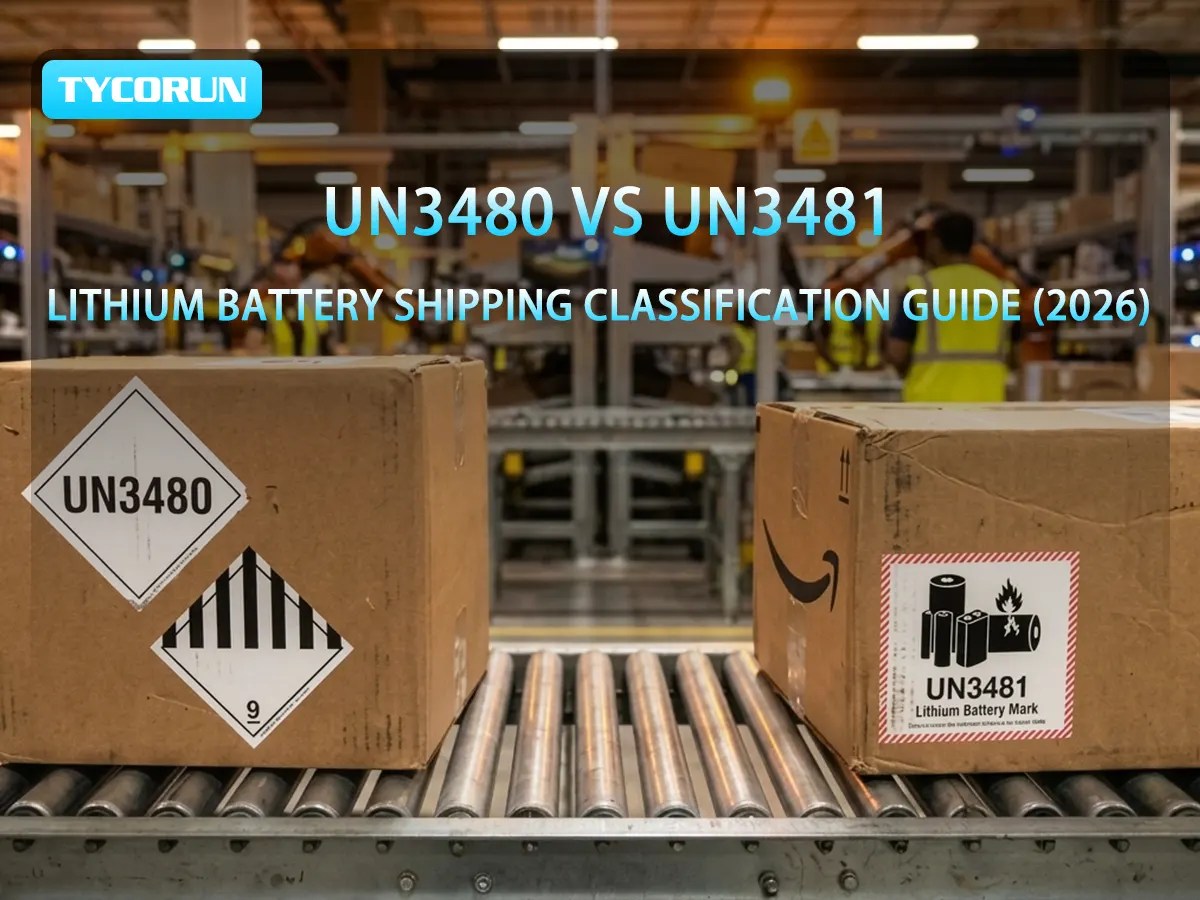
A shipment of custom lithium-ion battery packs gets tendered at the airport and comes straight back. The paperwork says UN3481. The cartons actually contain loose cells, no equipment. The ground handler reclassifies the goods as UN3480, rejects the declaration, and the factory either reworks the packing under a cargo-aircraft-only instruction or watches the order miss its delivery window.
This single-digit difference is among the costliest clerical errors in the battery business. UN3480 and UN3481 are not interchangeable: they describe two physically different configurations, each unlocking a different packing instruction, marks and labels, passenger-aircraft rules, and, new for 2026, different state-of-charge obligations. Get the number right and the rest of the dangerous goods system mostly follows; get it wrong and packaging, documents, and labels are all wrong at once.
- UN3480: Lithium ion batteries.The cells or batteries travel by themselves, not packed with or installed in the equipment they power. Standalone packs, loose replacement cells, power banks, and most factory shipments of custom battery packs fall here. They move by air under Packing Instruction 965 (PI965).[1][2]
- UN3481: Lithium ion batteries packed with equipment or contained in equipment.The batteries travel together with the device they power. “Packed with” (spare batteries in the same carton as a device) uses PI966; “contained in” (batteries physically installed in the device) uses PI967.[1][2]
Three things to know about shipping under these numbers in 2026:
- PI966 now carries a mandatory 30% state-of-charge (SoC) ceiling for most batteries packed with equipment, effective 1 January 2026.PI967 keeps SoC as a recommendation only. This is the biggest operational change of the year for equipment sellers.[2][3]
- Standalone lithium-ion batteries (UN3480) remain forbidden on passenger aircraftand fly cargo aircraft only, with a mandatory SoC of no more than 30% unless a dual competent-authority approval exists.[1][2]
- The old lithium battery mark printed with a telephone number is being phased out; marks without the number are the current design, and legacy stock may be used only through 31 December 2026.[4][14][15]
The rest of this guide covers classification, sections, the 2026 changes, marks and paperwork, mode differences, rejection causes, and an importer checklist.


What Is UN3480?
UN3480 is the proper shipping name “Lithium ion batteries” (including lithium polymer batteries) under Class 9, Miscellaneous Dangerous Goods. It applies whenever the cell or battery is the article being transported rather than a component inside something else.[1][2]
That scope is broader than many shippers assume. Under the IATA rules, a “battery” includes battery packs, modules, and assemblies whose primary function is to provide power to another piece of equipment, even if your sales department calls them “modules.” Power banks and power packs are explicitly classified as batteries, not as equipment, and ship as UN3480 (or UN3090 for lithium metal).[2]
Typical UN3480 cargo:
- Loose 18650/21700 cells and replacement cell lots
- Custom lithium-ion packs sold B2B for integration into e-bikes, power tools, solar kits, or medical devices
- UPS units that are essentially batteries in a cabinet
- Power banks and portable power stations
By air, UN3480 moves under PI965, split into Section IA and Section IB by Watt-hour rating. There is no lighter Section II path for standalone lithium-ion batteries anymore. Both sections require the Cargo Aircraft Only label, the Class 9 lithium battery label, UN specification or strong rigid packaging, a Shipper’s Declaration, and an SoC not exceeding 30%.[1][2][12]

What Is UN3481?
UN3481 is “Lithium ion batteries packed with equipment” or “Lithium ion batteries contained in equipment.” It is one UN number with two packing instructions, and the distinction depends on whether the battery is merely sharing the box with the device or is actually installed in it.[1][2]
- PI966 — batteries packed with equipment.
The battery and the equipment it is designed to power are in the same outer package, but the battery is not installed. Common examples: a spare battery packed beside a handheld scanner, or a tool body and a separate battery in the same carton. The batteries and equipment must be packed in inner packagings and protected against short circuit and damage.[2][12]
- PI967 — batteries contained in equipment.
The battery is physically installed in or integrated into the device: phones, laptops, tablets, e-bikes with the pack mounted, most finished consumer electronics. The equipment must protect the battery from damage and accidental activation, and spare batteries cannot be in the same package unless they are separately packed (which turns that part of the consignment into PI966).[2][12]
Both instructions are split into Section I (larger cells and batteries, fully regulated) and Section II (small cells and batteries below the thresholds that meet the exception’s limits). Section II removes some of the fully regulated burden, no Shipper’s Declaration, no UN specification packaging, but Section II batteries are still dangerous goods under the DGR: they need the battery mark, applicable SoC rules, and a compliance statement on the air waybill.[2][13]
A practical trap: a carton with both a device and a loose spare is not automatically PI967. The installed battery is PI967; the loose spare is PI966, and the package must satisfy PI966 for the whole consignment.

UN3480 vs UN3481: Side-by-Side Comparison
The table below compares the two classifications for air cargo under the 67th Edition of the IATA DGR (1 January–31 December 2026). Quantity limits are subject to stricter operator variations, so treat net-quantity figures as the regulatory floor and verify against the current DGR and your carrier’s checklist before tendering.[2][12][13]
| Dimension | UN3480 | UN3481 |
|---|---|---|
| Shipping configuration | Cells/batteries alone, not with or in equipment | Batteries packed with the device (PI966) or installed in it (PI967) |
| Air packing instruction | PI965 | PI966 (packed with) / PI967 (contained in) |
| Sections | IA and IB only — no Section II | Section I and Section II |
| Passenger aircraft | Forbidden as cargo (cargo aircraft only); limited A201 exceptions | Permitted within Section I/II limits |
| Labels (fully regulated) | Class 9 lithium battery label + CAO label; battery mark on IB | Class 9 label on Section I; battery mark on Section II; no CAO label |
| Shipper’s Declaration (DGD) | Required (IA and IB) | Required for Section I; Section II uses waybill statement |
| State of charge | Mandatory ≤30% (A331 approval to exceed) | PI966: mandatory ≤30% from 1 Jan 2026 above 2.7 Wh; PI967: recommended ≤30% (or ≤25% indicated) |
| Typical net quantity per package | IA 35 kg CAO; IB 10 kg CAO (verify against current DGR and operator variations) | Section I: 5 kg PAX / 35 kg CAO; Section II: 5 kg net of batteries (equipment excluded for PI967) |
| Packaging | UN specification (IA); strong rigid (IB) | UN specification (Section I); Section II non-UN packagings subject to 3 m stack test |
| Typical B2B shipment | Cell lots, custom packs, power banks, spares sold separately | Finished devices, tool+battery kits, electronics with installed cells |
| Handling profile | Highest: DG surcharge, freighter routing, trained shipper | Lighter under Section II; still regulated dangerous goods |
The 20 Wh/100 Wh Thresholds: Choosing Section I, IA, IB, or II
- Lithium-ion cell: 20 Wh
- Lithium-ion battery: 100 Wh
- PI965 (UN3480, batteries alone):cells over 20 Wh or batteries over 100 Wh go to Section IA; small cells and batteries go to Section IB. Both are cargo-aircraft-only, fully regulated, with a Shipper’s Declaration.[2][12]
- PI966 and PI967 (UN3481):cells over 20 Wh or batteries over 100 Wh require Section I (UN specification packaging, Class 9 label, DGD). Small cells and batteries meeting the quantity and packaging conditions may move under Section II, battery mark, no DGD, and a compliance statement on the transport document.[2][3][12]
The Myth That Will Not Die: "PI965 Section II"
Plenty of older blog posts, forwarder brochures, and supplier quotation templates still describe a “PI965 Section II” route for small standalone lithium-ion batteries, a light-touch path with only a battery mark and no Shipper’s Declaration. That option no longer exists. The ICAO Technical Instructions removed the Section II exception for standalone lithium-ion and lithium metal batteries, with the transition ending 31 March 2022; since the 63rd Edition of the IATA DGR (2022), and firmly under the 2023 and later editions, PI965 contains only Sections IA and IB.[2][9][12]
Any 2026 shipment of loose lithium-ion batteries tendered as “PI965 Section II” is misdeclared on its face, and usually travels with missing labels, missing declarations, and passenger-aircraft bookings, exactly the pattern cargo screeners are trained to stop. A supplier quoting “Section II” for standalone packs is a red flag on their dangerous-goods competence, not a cost-saving option.
What Changed for 2026: DGR 67th Edition Rules That Affect Buyers
PI966 Batteries Now Need a 30% State of Charge
- PI966 Section I: all lithium-ion cells and batteries must be offered at an SoC not exceeding 30% of rated capacity.
- PI966 Section II: cells and batteries with a Watt-hour rating above 2.7 Wh must be at no more than 30%. (The 2.7 Wh line sweeps in essentially every practical pack; only the smallest cells sit below it.)
- Anything above 30% may ship only under Special Provision A331, with written approval from both the authority of the State of Origin and the authority of the State of the Operator, under those authorities’ written conditions.
PI967 Stays at Recommended SoC, for Now
Sodium-Ion Batteries Are Now Fully in the System
Marks, Labels, and Test Evidence
The current battery mark (red-hatched rectangle with the battery-and-flame symbol and UN number) must show the applicable UN number, UN3480 or UN3481 for lithium-ion, UN3551/3552 for sodium. Old-design marks with a telephone-number space remain usable only through 31 December 2026; the telephone-number requirement was removed internationally on 1 January 2023.[3][4][14]
Every lithium-ion cell and battery must be of a type tested under Section 38.3 of the UN Manual of Tests and Criteria (Revision 8 / Amendment 1 has applied to newly tested designs since 1 January 2023), and the manufacturer or distributor must make the test summary available on request, a URL or QR code is acceptable; the paper report need not travel with the box. Button cells installed in equipment are exempt.[2]
Looking to 2027 (Forward-Looking)
Changes signaled for the 68th Edition of the IATA DGR (2027), aligned with ICAO’s harmonization with the 24th revised edition of the UN Model Regulations feeding the 2027–2028 Technical Instructions, include provisions for hybrid packs containing both lithium-ion and sodium-ion cells, new UN numbers for batteries installed in cargo transport units (building on the existing UN3536 for lithium-ion, with UN3563 and UN3564 added for lithium metal and sodium ion), and formal phase-out of the legacy telephone-number mark.[5][9][14][15] These are forward-looking and not binding on 2026 shipments; plan label and artwork budgets around them, but tender against the current edition.
Separately, on 27 March 2026 ICAO published an addendum to the 2025–2026 Technical Instructions tightening passenger and crew rules for power banks: maximum two per person, carry-on only, no recharging on board, no checked-baggage carriage. It applies immediately and folds into DGR 68; IATA has indicated the operator-approval channel for 100–160 Wh power banks will not carry forward.[6][7][8] This is passenger-baggage law rather than cargo law, but it shapes carrier screening intensity around every lithium shipment.

Marks, Labels, and Paperwork: What the Carton and the Documents Need
A correctly classified consignment still needs the correct surface. Requirements split by section.[2][3][12]
- The battery mark (Section II, and PI965 IB)
A rectangle or square with red diagonal hatching at least 5 mm wide, the black battery-and-flame symbol on a contrasting background, and the applicable UN number in characters at least 12 mm high. Minimum dimensions are 100 mm × 100 mm, reducible to no less than 100 mm × 70 mm on small packages; elements must sit on one surface and not be folded across edges.[2][14]
- The Class 9 lithium battery label (Sections I, IA, IB)
The diamond hazard label with the battery-and-flame symbol, renamed in the 66th Edition as the “lithium battery or sodium ion battery label” to cover UN3551/3552. UN3480 packages additionally carry the Cargo Aircraft Only label. Section II packages carry the battery mark without a Class 9 label.[3][5][12]
- Documentation
Sections I, IA, and IB require a Shipper’s Declaration for Dangerous Goods (DGD) showing the packing instruction and section (for example, “965, IB”) and net battery weight. Section II needs no DGD, but the air waybill must carry the applicable statement, such as “Lithium ion batteries in compliance with Section II of PI 966” (or the PI 967 wording), with box counts and marks matching.[3][12]
- Packaging performance
UN specification packaging (Packing Group II performance level) is required for PI965 IA and Section I paths; PI965 IB uses strong rigid outer packaging, and certain non-UN packagings for PI966 Section II and PI967 must meet the 3 m stacking test condition added in recent editions, confirm this with your packhouse rather than assuming a plain master carton qualifies.[2][12]
Damaged, defective, or recalled lithium batteries are forbidden in air transport outright; no higher section fixes them. By sea they may move, if at all, only under case-by-case approval.[2][12][11]
Air vs. Sea vs. Road: The Mode Question
Classification follows the goods; the operational rules change with the mode. Buyers who plan logistics around one mode’s allowances get surprised at transshipment.
- Air (IATA DGR / ICAO Technical Instructions)
The tightest regime. Standalone lithium-ion is freighter-only at ≤30% SoC with full DG paperwork; packed-with and contained-in equipment has the lighter Section II structure described above, with the new PI966 SoC mandate. The 20 Wh/100 Wh thresholds, the battery mark, and the declaration rules in this guide are air rules.[1][2]
- Sea (IMDG Code, Amendment 42-24)
Voluntary in 2025, mandatory from 1 January 2026, it brings sodium-ion entries (UN3551/3552) and battery-powered vehicle entries (UN3556–3558) into the sea code, with P912 packaging. Ocean transport imposes no 30% SoC ceiling on normal battery shipments, and damaged or recalled batteries may be considered case by case under competent-authority approval, one reason non-conforming stock sometimes moves by sea when it cannot fly. Excepted provisions still require the lithium battery mark and documented classification.[10][11]
- Road and rail (ADR/RID in Europe; 49 CFR in the United States)
Surface rules are more permissive. Under US 49 CFR §173.185, lithium cells and batteries transported by highway or rail may use higher size thresholds, cells up to 60 Wh and batteries up to 300 Wh can qualify for the lighter “small lithium battery” conditions, well above the air-mode 20 Wh/100 Wh line, subject to packaging, marking, and incident-prevention conditions, and the US regulation carries the same 31 December 2026 end date for the legacy telephone-number mark.[14] ADR offers parallel exceptions (such as Special Provision 188) for small cells and batteries in European road transport.
The planning point is concrete: a pack that is fully regulated, freighter-only cargo by air can be an unremarkable pallet by sea or truck, and goods legal into a US port under 49 CFR must still be re-prepared to IATA standards if the final leg flies. Pick the mode before printing artwork and paperwork.
Common Mistakes That Get Lithium Shipments Rejected
- Declaring UN3481 for loose packs. Cartons of standalone cells or custom packs labeled UN3481/PI966 or PI967 are the classic misdeclaration; handlers reclassify them to UN3480/PI965 and refuse the package because CAO labeling, DGD, and packaging do not match.[1][2]
- Still quoting “PI965 Section II.” That exception ended with the 2022 transition. Every standalone lithium-ion shipment by air is IA or IB, fully regulated.[2][12]
- Shipping PI966 spares at 100% charge after 1 January 2026. The new mandatory ≤30% SoC rule for packed-with batteries above 2.7 Wh catches suppliers on 2025 procedures; without A331 dual-state approval the carton is non-compliant.[2]
- Mixing PI966 and PI967 in one box without thinking. A device with an installed battery plus a loose spare makes the package PI966; marking it PI967 understates the requirements.
- Missing or stale marks. No battery mark on a Section II package; a mark with no UN number; or old telephone-number artwork still in use after the 31 December 2026 deadline.[3][14]
- No test-summary trail. Trading companies that cannot produce the UN 38.3 test summary for the actual cell manufacturer; a marketing datasheet is not a substitute.[2]
- Booking cargo-aircraft-only goods on passenger flights. UN3480 is forbidden in passenger-aircraft cargo; routing errors surface as hub offloads, not at origin.[1][2]
- Confusing passenger rules with cargo rules. The 100 Wh/160 Wh personal-baggage allowances and the 2026 two-power-bank limit govern what people carry on board; they are not commercial shipping exemptions and do not authorize “sample” shipments in luggage.[6][8]
- Ignoring operator and state variations. Airlines file variations stricter than the DGR, extra attestations, DG-location-only acceptance, outright refusal of recalled or special-provision stock. An IATA-baseline permit does not bind the carrier.[12][13]
Buyer's Compliance Checklist: What to Require From Your Battery Supplier
Before the next PO ships, require written confirmation of each item:
- [ ] Correct classification: UN3480 for standalone packs and spares; UN3481 only when batteries travel with (PI966) or inside (PI967) the equipment.
- [ ] Correct section against the 20 Wh/100 Wh thresholds, with Wh ratings marked on each cell/battery and shown on spec sheets.
- [ ] UN 38.3 test summary for every design type (Revision 8 / Amendment 1 for new designs), provided via document, URL, or QR code on request.
- [ ] SoC procedure: mandatory ≤30% for PI965 and, from 2026, PI966 batteries above 2.7 Wh; lot charge records; A331 dual-state approval lined up before any exception shipment.
- [ ] Packaging matched to section: UN specification for IA/Section I, strong rigid for IB, and evidence of the 3 m stacking condition for Section II non-UN packaging.
- [ ] Current-design marks and labels: battery mark with the correct UN number (100 × 100 mm minimum; 100 × 70 mm for small packages), Class 9 and CAO labels where required, no telephone-number artwork after 31 December 2026.
- [ ] Paperwork: Shipper’s Declaration for IA/IB/Section I; the correct Section II statement on the air waybill; accurate net battery weights.
- [ ] Mode planning: freighter capacity for UN3480; IMDG 42-24 or 49 CFR/ADR preparation where sea or surface legs are legal and cheaper; no last-minute mode switch without re-packing.
- [ ] Operator-variation matrix checked with the actual carrier before booking, covering origin, transit, and destination states.
- [ ] No damaged, defective, or recalled stock offered for air; a quarantine process keeps such units out of export cartons.
Chemistry is upstream of all of this. The pack design your factory builds, cathode chemistry, cell format, Wh rating, enclosure, decides which thresholds and packing instructions you live with on every shipment, so shipping compliance starts at the design stage, not after the pack is built. A well-designed battery management system also plays a role, since it controls the overcharge, over-discharge, and short-circuit conditions that affect risk during handling and transit; see our broader overview of lithium-ion battery safety for more.
If your supplier can hand you correct UN numbers, SoC records, and 38.3 summaries without a chase, that capability is worth as much as unit price. TYCORUN provides a UN38.3 test report and MSDS with every batch we ship, regardless of whether the order ships under UN3480 or UN3481, and our team can confirm the applicable classification during the quoting stage of your custom battery pack order, based on how the batteries will ship with your equipment.
Frequently Asked Questions
No. All lithium-ion cells and batteries shipped by themselves (UN3480, PI965) are forbidden for transport as cargo on passenger aircraft and move on cargo aircraft only, with the Class 9 lithium battery label and Cargo Aircraft Only label. Narrow exceptions exist under Special Provision A201, for example, urgent medical shipments with prior approval of the State of Origin authority and the operator, but ordinary commercial orders use freighter capacity.[1][2]
Not as a mandatory requirement in the 2026 DGR. The 30% SoC (or 25% indicated capacity) ceiling for PI967 remains a strong IATA recommendation and a common carrier acceptance condition. The mandatory 30% rule applies to standalone batteries under PI965 and, from 1 January 2026, to batteries packed with equipment under PI966 where the cell or battery exceeds 2.7 Wh.[2]
No. The Section II exception for standalone lithium-ion batteries was removed from the ICAO Technical Instructions, with the transition ending on 31 March 2022, and the IATA DGR has contained only Sections IA and IB for PI965 since the 63rd Edition (2022). Any supplier offering "PI965 Section II" for a 2026 shipment is working from obsolete rules.[2][12]
Power banks are classified as batteries, not equipment, because their primary function is supplying power to another device. They ship as cargo under UN3480/PI965 (or UN3090 for lithium metal), never as PI967. For passengers, ICAO's 27 March 2026 addendum limits personal power banks to two per person, carry-on only, with no in-flight recharging, and the 100–160 Wh operator-approval allowance is set to disappear from DGR 68.[2][6][7]
Sources
[1] IATA, Lithium Batteries — official guidance and classification page.
[8] UK Civil Aviation Authority, Changes to rules on the carriage of lithium cells/batteries and power banks (effective 27 March 2026).
[9] ICAO, Dangerous Goods Programme — Technical Instructions and addenda (Doc 9284).
[10] IMO, Dangerous Goods and the IMDG Code.
[11] Maersk, Shipping batteries safely (lithium battery air vs ocean requirements; IMDG Amendment 42-24; damaged batteries).
[12] DHL Express, 2026 Lithium and Sodium Battery Shipping Guidelines v2.1 (DGR 67-aligned PI tables, net quantities, packaging and documentation).
[13] FedEx, 2026 Battery Shipping Overview (DGR 67-based operator acceptance requirements and variations).
[15] UNECE, UN Model Regulations (Rev.23/Rev.24) — Dangerous Goods.
[16] Civil Aviation Administration of China, ICAO Council adoption of Technical Instructions revisions on lithium batteries and power banks (April 2026, Chinese).

Typical industry-cited parameter ranges across each stage of lithium-ion battery production, from slurry mixing to formation and aging, for engineers and QA teams.

The best custom lithium ion battery pack manufacturer is not always the largest or the cheapest. Learn how to evaluate factory size, certifications, production capacity, and engineering capability before requesting a quotation.

This article covers lithium battery types, transport regulations, proper packaging, required documents, and carrier selection for safe, compliant shipping.
Authors
-
 View all posts
Ryder is a hands-on lithium battery specialist and technical content author with over five years of deep field experience in electric mobility infrastructure. He specializes in cell testing, pack diagnostics, and real-world Battery Management System (BMS) performance analysis. Having collaborated closely with top-tier R&D teams, Ryder excels at evaluating battery safety against stringent global standards like UN38.3 and IEC 62133. Through his articles, he aims to eliminate marketing noise, offering readers raw, data-driven insights into battery safety, performance, and lifespan optimization.
-
 View all posts
Meg is a battery engineer with 10+ years of experience in the energy storage industry. She holds a B.S. in Electrical Engineering and previously worked as an R&D engineer at a lithium-ion battery manufacturer, where she focused on battery management systems (BMS), charging algorithms, and life-cycle testing for lead-acid, AGM, and lithium chemistries. She has contributed to the development of battery maintenance technologies used in commercial products. Meg now provides technical review for energy storage content to ensure accuracy, safety, and practical value for readers.