


Last Updated on June 25, 2026
With over €15 billion in investment flowing in from leading Chinese and Korean battery giants, Hungary has emerged as one of Europe’s most important EV battery manufacturing hubs. CATL’s €7.3 billion gigafactory in Debrecen began cell production in early 2026, while Samsung SDI and SK On already operate a combined 87.5 GWh of annual capacity in the country. Hungary is on track to represent roughly one-third of Europe’s total battery output by 2030.
This article profiles the top 10 battery manufacturers operating or investing in Hungary, with the latest data and production updates as of June 2026.
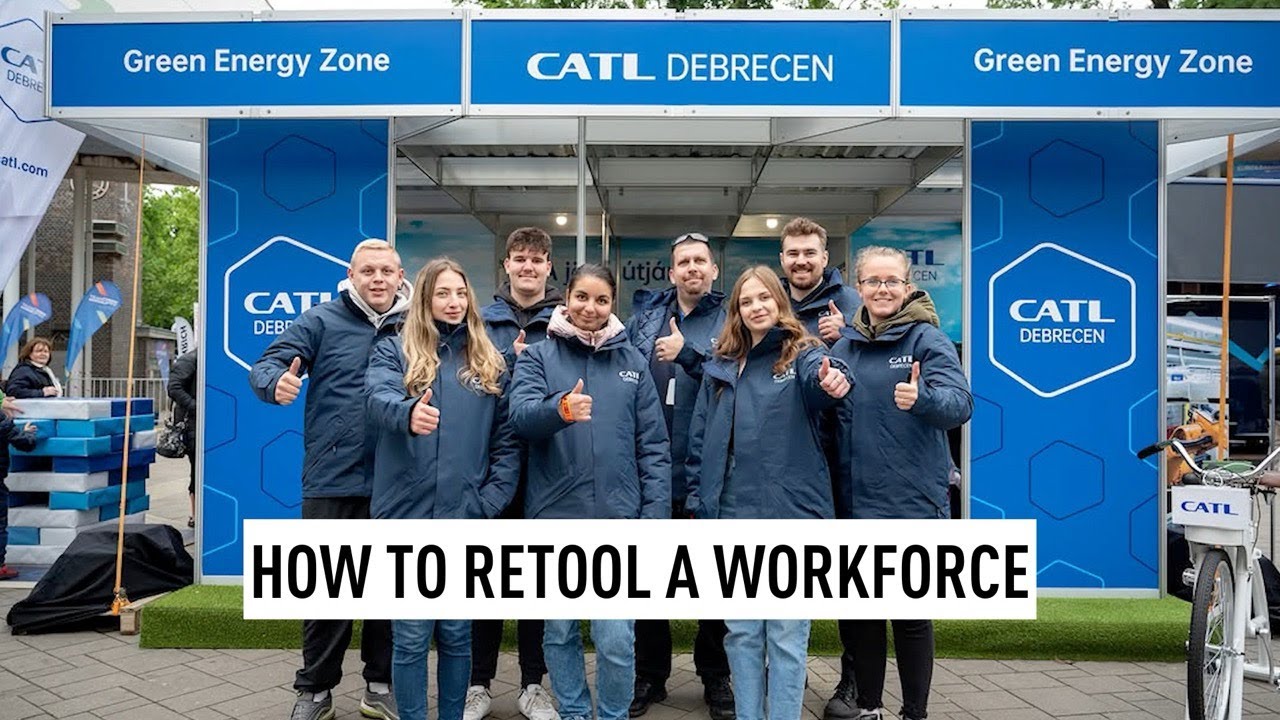

Top 10 Battery Manufacturers in Hungary 2026
| Ranking | Manufacturer | Country of Origin | Key Location in Hungary |
|---|---|---|---|
| 1 | CATL | China | Debrecen |
| 2 | Samsung SDI | South Korea | Göd |
| 3 | SK On | South Korea | Komárom, Iváncsa |
| 4 | BYD | China | Komárom, Szeged |
| 5 | EVE Energy | China | Debrecen |
| 6 | EcoPro BM | South Korea | Debrecen |
| 7 | Sunwoda | China | Nyíregyháza |
| 8 | GS Yuasa | Japan | Miskolc |
| 9 | Inzi Controls | South Korea | Komárom |
| 10 | Huayou Cobalt | China | TBD |
CATL

| Estabilished | 2011 |
|---|---|
| Official Website | www.catl.com |
| Headquarter | Fujian, China |
| Hungary Location | Debrecen |
| Investment | €7.3 billion |
| Planned Capacity | 40 GWh (Phase 1) → 100 GWh (full build-out) |
CATL is the world’s largest EV battery manufacturer, holding approximately 38% of the global market share as of 2024. Its Debrecen facility represents the largest single foreign investment in Hungary’s history and is set to become one of the most significant battery production sites in Europe.

Hungary Operations (2026 Update): The Debrecen gigafactory began cell production in early 2026, with an initial annual capacity of 40 GWh — all of which is already fully booked by customers. The total investment stands at €7.3 billion, covering a site of approximately 220 hectares. Once fully built out, the plant will reach 100 GWh annually and employ up to 9,000 people. As of Q1 2026, the local workforce has reached approximately 1,500 employees. Module assembly had already been running for over a year prior to cell production launch.
The plant supplies batteries to major European automakers including BMW, Stellantis, Mercedes-Benz, and Volkswagen, and has achieved ISO 14001 environmental management certification. CATL has also implemented water-saving technologies that cut potable water demand to one-third of standard levels, and reduced energy use by nearly 30% compared to its earlier environmental permit.
Key Battery Products:
- Shenxing Plus Battery: Provides 600 km range with just 10 minutes of charging
- Freevoy Super Hybrid Battery: Designed for EREVs and PHEVs, offering 280+ km range with a 10-minute charge
- Choco-Swap Ecosystem: Standardized battery swapping models for minimal EV downtime
- LFP (Lithium Iron Phosphate) Batteries: Cobalt-free, enhanced safety and sustainability
Samsung SDI

| Estabilished | 1970 |
|---|---|
| Official Website | www.samsungsdi.com |
| Headquarter | Gyeonggi-do, South Korea |
| Hungary Location | Göd (north of Budapest) |
| Investment | €1.5 billion+ (ongoing expansion) |
| Planned Capacity | ~40 GWh (expanding to 60 GWh by 2026) |
Samsung SDI was the first company to open an EV battery factory in Hungary, converting a former television screen plant in Göd in 2017. Today, its two Göd factories have a combined annual capacity of approximately 40 GWh, producing prismatic cells primarily for BMW and Volkswagen.

Hungary Operations (2026 Update): In 2025, Samsung SDI announced a €1 billion expansion and modernisation of its Göd plant, which will switch the first factory from wound cells to high-energy-density stacked cells and increase total capacity to approximately 60 GWh by 2026. The company raised approximately €1.05 billion in May 2025, partly to fund this refurbishment.
Samsung SDI has also secured a significant new contract: the Göd plant will produce Volkswagen’s Unified Cell, making Samsung SDI the third supplier of this format after PowerCo and Gotion, with mass production targeted for 2027. Additionally, the company holds a long-term supply agreement with Hyundai and Kia to supply 6th-generation NCA stacked cells from 2026 to 2032 — covering roughly 500,000 vehicles per year. A proposed third factory in Hungary (on a 97–162 hectare site) was ultimately shelved due to changing market conditions.
Key Battery Products:
- Prismatic NCA cells (high-nickel, 91%+ nickel content)
- 6th-generation P6 stacked prismatic cells (silicon-carbon nanocomposite anode)
- Volkswagen Unified Cell (in development, mass production 2027)
SK On

| Estabilished | 2019 (spun off from SK Innovation) |
|---|---|
| Official Website | www.sk-on.com |
| Headquarter | Seoul, South Korea |
| Hungary Location | Komárom (2 plants), Iváncsa (1 plant) |
| Total Investment in Hungary | ~€3.3 billion |
| Total Hungary Capacity | 47.5 GWh |
SK On is one of the largest EV battery producers in Europe, operating three factories in Hungary that together form the backbone of its European supply chain.

Hungary Operations (2026 Update): SK On’s first Komárom plant began production in 2020, followed by a second Komárom plant in 2022. The two combined have grown from an initial 7.5 GWh capacity to approximately 16 GWh. In 2024, SK On’s third and largest Hungarian factory — located in Iváncsa, 51 km southwest of Budapest — began mass production with a 30 GWh annual capacity, bringing SK On’s total European output to 47.5 GWh.
The Iváncsa plant achieved over 90% yield rate within just three months of production launch, and local authorities renamed the road in front of the facility “SK Road” in recognition of its economic impact. SK On’s Hungarian plants supply major automakers including Hyundai, Kia, Ford, and Volkswagen.
Key Battery Products:
- NCM (Nickel-Cobalt-Manganese) pouch cells
- High-nickel NCM9 cells
- LFP (Lithium Iron Phosphate) cells
- Fast-charging battery solutions
BYD

| Estabilished | 1995 |
|---|---|
| Official Website | www.byd.com |
| Headquarter | Shenzhen, China |
| Hungary Location | Komárom (bus factory), Szeged (EV car factory) |
| Investment | ~€500 million |
BYD is the world’s largest new energy vehicle manufacturer and has been present in Hungary since 2017, when it opened its first European electric bus factory in Komárom.

Hungary Operations (2026 Update): BYD’s Komárom bus factory has been expanded with a new 29,000 m² extension building, aiming to triple electric bus capacity to over 1,000 units per year and creating 600+ new jobs. More significantly, BYD is building its first European passenger car factory in Szeged, with an investment of approximately €500 million and an initial capacity of 150,000 vehicles per year (ultimately targeting 300,000 units).
Mass production has been delayed to 2026, with output in the first year expected to be in the tens of thousands as production ramps up. BYD also plans to establish its European headquarters and an R&D centre in Budapest.
Key Battery Products:
- Blade Battery: LFP chemistry; enhanced structural safety, longer cycle life
- Sodium-ion batteries (in production since 2023)
- EV battery packs for buses, trucks, and passenger cars
EVE Energy

| Estabilished | 2001 |
|---|---|
| Official Website | www.evebattery.com |
| Headquarter | Guangdong, China |
| Hungary Location | Debrecen |
| Investment | ~€1.3 billion |
| Planned Capacity | 30 GWh |
EVE Energy is a leading Chinese battery manufacturer specialising in large cylindrical cells. Its Debrecen plant, located within the same industrial park as BMW’s new Hungarian EV factory, is being built specifically to supply BMW’s next-generation “Neue Klasse” electric vehicles.

Hungary Operations (2026 Update):
EVE Energy’s first European factory in Debrecen is under construction with a targeted annual capacity of 30 GWh, producing 46 mm diameter large cylindrical cells. The plant sits adjacent to BMW’s new Debrecen production facility to maximise supply chain efficiency. Operations are expected to begin in 2026 in line with BMW’s production ramp-up. The investment of approximately €1.3 billion makes EVE Energy one of the largest foreign investors in eastern Hungary alongside CATL.
Key Battery Products:
- Large cylindrical cells (46 mm format)
- Consumer lithium batteries
- Energy storage batteries
EcoPro BM

| Estabilished | 1998 |
|---|---|
| Official Website | www.ecoprobm.co.kr |
| Headquarter | Cheongju, South Korea |
| Hungary Location | Debrecen (Southern Industrial Park) |
| Investment | ~€830 million |
| Annual Capacity | 108,000 tonnes (full build-out) |
EcoPro BM is South Korea’s largest cathode material manufacturer and a critical upstream supplier in the global EV battery supply chain. The company’s Debrecen project marks its first European manufacturing base and a major addition to Hungary’s battery ecosystem.

Hungary Operations (2026 Update): Completed in late 2025, the complex was designed to support the rapid expansion of EV battery production in Europe and to serve as a key source of cathode materials for major cell makers. Phase 1 of the plant has an annual capacity of 54,000 tonnes, with full build-out expected to reach 108,000 tonnes. The Debrecen site is especially important because it strengthens the local supply chain around Samsung SDI’s Göd factory and helps Hungary attract more battery-related investment across the value chain.
Key Products:
- High-nickel NCA cathode materials (91%+ nickel, for Samsung SDI P6 cells)
- High-nickel NCM cathode materials
- Mid-nickel and LFP cathode materials (planned expansion)
- Lithium hydroxide (via EcoPro Innovation, 8,000 tonnes/year)
Sunwoda

| Estabilished | 1997 |
|---|---|
| Official Website | www.sunwoda.com |
| Headquarter | Shenzhen, China |
| Hungary Location | Nyíregyháza |
| Investment | €245 million (initial phase); up to €1.5 billion long-term |
Sunwoda is a major Chinese lithium-ion battery manufacturer with over 36,000 employees globally and a 51-million-square-foot production base. After 20+ years of innovation, the company has expanded beyond consumer batteries into power batteries, energy storage, and smart hardware.

Hungary Operations: Sunwoda announced in mid-2023 that it would build its first European manufacturing facility in Nyíregyháza, in northeastern Hungary. The initial investment of €245 million is expected to create over 1,000 local jobs, with the potential to scale up to nearly €1.5 billion in total investment over the medium to long term.
Key Battery Products:
- Lithium-ion battery modules (consumer and power)
- Energy storage systems
- Power battery and powertrain solutions
GS Yuasa

| Estabilished | 1917 (merged entity, 2004) |
|---|---|
| Official Website | www.gs-yuasa.com |
| Headquarter | Kyoto, Japan |
| Hungary Location | Miskolc |
| Initial Capacity | 500,000 units/year |
GS Yuasa Corporation is a Japanese battery manufacturer formed through the 2004 merger of Yuasa Corporation and Japan Storage Battery Co., Ltd. The company produces lead-acid and lithium-ion batteries for automotive, motorcycle, aerospace, and defence applications, and holds a dominant ~90% share of the North American power sports battery market.

Hungary Operations: GS Yuasa Hungary Ltd., established in 2017 in Miskolc, is the company’s first overseas lithium-ion battery plant. It began producing 12V lithium-ion starter batteries for passenger cars in 2019, initially using cells imported from Japan, with a capacity of 500,000 units per year. The Miskolc plant serves as GS Yuasa’s European production base, with future expansion plans including on-site cell manufacturing.
Key Battery Products:
- 12V lithium-ion automotive starter batteries
- Lead-acid batteries (automotive and industrial)
- Lithium-ion cells for aerospace and defence
Inzi Controls

| Estabilished | 1978 |
|---|---|
| Official Website | www.inzicontrols.net |
| Headquarter | Gyeonggi-do, South Korea |
| Hungary Location | Komárom |
| Investment | €45 million+ |
Inzi Controls is a South Korean manufacturer specialising in battery module production equipment, battery management systems, and EV battery packs. The company collaborates closely with SK Innovation, LG Chem, and Samsung SDI.

Hungary Operations: Inzi Controls opened its first European EV battery manufacturing facility in Komárom in 2019, with an investment of over €45 million and government support. The plant initially employed 122 people and supplies battery modules to European automakers including Audi, Continental, and Volkswagen. The Komárom location was strategically chosen for its proximity to SK On’s battery plants in the same city.
Key Products:
- EV battery modules and packs
- Battery module manufacturing equipment
- Battery management systems
Huayou Cobalt

| Estabilished | 2002 |
|---|---|
| Official Website | www.huayou.com |
| Headquarter | Tongxiang, Zhejiang Province, China |
| Hungary Location | Ács, Komárom-Esztergom County |
| Total Investment | €1.3 billion |
| Full Capacity | 100,000 tonnes/year |
Zhejiang Huayou Cobalt Co., Ltd. is one of China’s leading new energy battery materials companies and a major upstream supplier in the global EV battery supply chain. The company provides high-nickel ternary cathode materials and cobalt-based materials to major battery manufacturers such as CATL, EVE Energy, AESC, and LG Energy Solution.

Hungary Operations: In Hungary, Huayou announced its investment in June 2023 and selected Ács in Komárom-Esztergom County for its first European manufacturing base, thanks to its strategic location near Audi’s Győr plant and Inzi Controls’ battery facility in Komárom. The project represents a total investment of nearly €1.3 billion and is planned to reach 100,000 tonnes of cathode material per year at full build-out, while creating around 900 new jobs.
The first phase, with an investment of €252 million, is designed for 25,000 tonnes of annual capacity and is expected to start operations by the end of 2025 or in early 2026. The Ács plant is expected to serve battery makers supplying EVs from brands such as BMW, Volkswagen, and Renault, strengthening Hungary’s role as a key battery supply-chain hub in Europe.
Key Products:
- Ternary precursor materials (NMC cathode precursors)
- Cobalt tetroxide
- Nickel sulphate
- Cobalt hydroxide
These materials are used in aerospace superalloys, 3C product batteries, EV power batteries, and industrial catalysts. As EV battery supply chains localise into Europe, Huayou Cobalt’s upstream materials position makes it a strategic partner for battery manufacturers investing in Hungary.
Hungary Battery Industry Overview (2026)
Hungary has attracted investment from both Chinese and Korean battery giants, making it one of the world’s fastest-growing battery manufacturing hubs. The table below summarises key operational facilities:
| Company | Location | Current/Planned Capacity | Investment | Key Customers |
|---|---|---|---|---|
| Samsung SDI | Göd | 40 GWh → 60 GWh (2026) | €1.5B+ | BMW, VW, Hyundai |
| SK On | Komárom + Iváncsa | 47.5 GWh | ~€3.3B | Hyundai, Kia, Ford |
| CATL | Debrecen | 40 GWh → 100 GWh | ™€7.3B | BMW, Mercedes, VW, Stellantis |
| EVE Energy | Debrecen | 30 GWh (planned) | ~€1.3B | BMW |
| BYD | Szeged | 150,000 vehicles/yr (EV plant) | ~™€500M | — |
| GS Yuasa | Miskolc | 500,000 units/yr | — | Automotive OEMs |
| Inzi Controls | Komárom | — | €45M+ | Audi, VW, Continental |
Industry context: Hungary’s battery production fell 51% in 2024 due to weaker-than-expected European EV demand, but 2026 marks a turning point as CATL’s Debrecen cell lines come online and SK On’s Iváncsa plant ramps to full capacity. Hungary is expected to account for roughly one-third of Europe’s total battery production capacity by 2030, alongside Germany and Poland as the continent’s three key battery manufacturing hubs.
Frequently Asked Questions
Hungary offers a combination of central European location, proximity to major German automakers (BMW, Mercedes, Audi, Volkswagen), competitive labour costs compared to Western Europe, strong government incentives, and an established automotive manufacturing workforce. Prime Minister Orbán's government has actively courted Chinese and Korean battery investment as a pillar of its industrial strategy.
CATL's Debrecen gigafactory is the largest, with a planned ultimate capacity of 100 GWh and a total investment of €7.3 billion — the largest single foreign investment in Hungarian history. In terms of currently operational capacity, SK On leads with 47.5 GWh across its three Hungarian plants.
CATL's Debrecen factory began cell production in early 2026. Module assembly had been running for over a year prior. The initial capacity of 40 GWh is already fully committed to customers including BMW, Stellantis, Mercedes-Benz, and Volkswagen.
Yes. BMW opened its new electric vehicle factory in Debrecen in 2025, and BYD's first European passenger car factory in Szeged began ramping up production in 2026. Mercedes-Benz also has a long-established manufacturing presence in Kecskemét.
As of 2026, Hungary's operational battery cell capacity exceeds 87.5 GWh (Samsung SDI ~40 GWh + SK On 47.5 GWh), with CATL's 40 GWh Debrecen plant now coming online. Hungary is targeting approximately 200 GWh of total capacity by 2030.
Conclusion
Hungary has firmly established itself as Europe’s most dynamic EV battery manufacturing hub, with over €15 billion in committed investment and a supply chain that now spans cell production, cathode materials, and vehicle assembly. With CATL’s Debrecen gigafactory now in production, SK On operating 47.5 GWh of capacity across three plants, and upstream suppliers like EcoPro BM and Huayou Cobalt coming online, Hungary’s battery ecosystem is entering a new phase of maturity.
For businesses sourcing battery products or exploring supply chain partnerships in Europe, Hungary’s concentration of tier-1 manufacturers makes it one of the most strategically important markets to monitor. If you’re looking to connect with battery manufacturers operating in Hungary or across Europe, contact our team for tailored sourcing support.
Interested in how Hungary compares to other European battery hubs? Read our related guides: Top 10 Battery Manufacturers in Europe; Top 10 Battery Manufacturers in Germany; Top 10 Battery Manufacturers in Poland
Last updated: June 2026. Data sourced from company announcements, Reuters, Bruegel European Clean Tech Tracker, and industry reports.
Authors
-
View all posts
Hi, I am Caroline. Right now, I mainly edit articles about lithium batteries and related parts. I'm focused on providing services and solutions for different industries using lithium batteries, and I keep up with the latest news on the topic. I look forward to collaborating with you all to advance the new energy industry!
-
View all posts
Meg is a battery engineer with 10+ years of experience in the energy storage industry. She holds a B.S. in Electrical Engineering and previously worked as an R&D engineer at a lithium-ion battery manufacturer, where she focused on battery management systems (BMS), charging algorithms, and life-cycle testing for lead-acid, AGM, and lithium chemistries. She has contributed to the development of battery maintenance technologies used in commercial products. Meg now provides technical review for energy storage content to ensure accuracy, safety, and practical value for readers.






