Last Updated on July 4, 2026
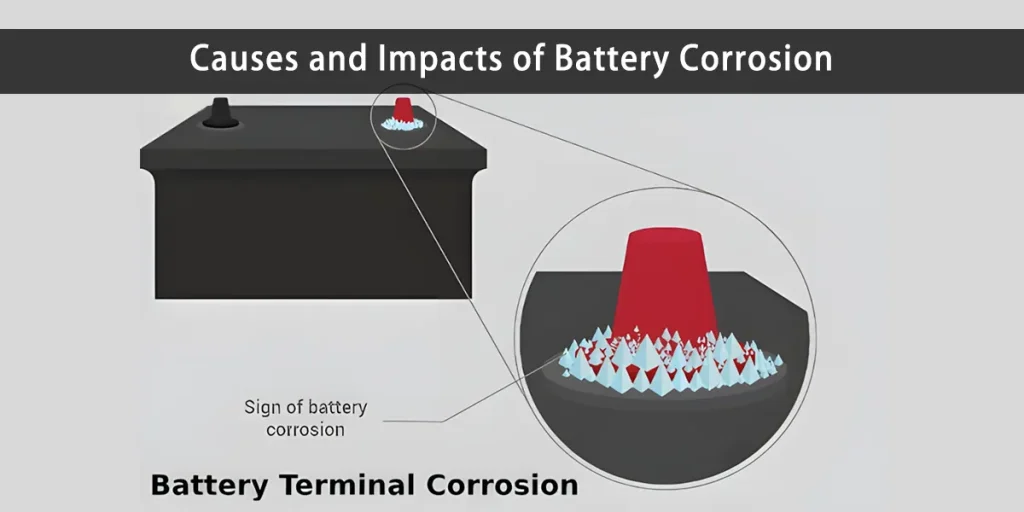
Your car won’t start. You pop the hood and find white or green crust covering the battery terminals. That’s corrosion — and in most cases, you can fix it yourself in under 10 minutes.
This guide shows you exactly what to do, step by step. But more importantly, it explains why corroded battery terminals keep coming back — and when repeated cleaning means the problem isn’t your technique. It’s your battery chemistry.
Before you start cleaning, confirm the symptoms match:
| Symptom | Likely Cause | Action |
|---|---|---|
| White, blue, or green powder on terminals | Sulfate or copper corrosion | Cleanable at home |
| Clicking sound when turning key | Low voltage from poor connection | Clean terminals first |
| Lights work but engine won’t crank | High resistance at terminals | Clean or jump-start |
| Rotten egg smell + wetness around battery | Lead-acid battery venting gas | Do not clean — replace immediately |
| Swollen or cracked battery case | Internal damage | Replace immediately |
Safety Warning: If you smell rotten eggs or see the battery case swollen, do not attempt to clean corroded battery terminals. The battery is internally damaged and potentially dangerous. Replace it immediately. This symptom is characteristic of lead-acid batteries under stress — lithium car batteries do not produce hydrogen sulfide.
What You'll Need
You probably have most of these at home already:
- Baking soda — 1 tablespoon
- Warm water — 1 cup
- Old toothbrush or small wire brush
- Clean rag or paper towels
- Wrench — typically 10mm
- Petroleum jelly or dielectric grease — optional but recommended
- Safety glasses and gloves — if you have them
No baking soda? Coca-Cola can dissolve the buildup in a pinch — the phosphoric acid works — but it leaves a sticky sugar residue. Use it only as a temporary fix, then clean properly with baking soda when possible.
How to Clean Corroded Car Battery Terminals: 3 Steps in 10 Minutes
Step 1: Disconnect the Battery (2 minutes)
Turn off everything. Engage the parking brake. Remove the ignition key.
Always disconnect the negative (−) terminal first, then the positive (+). This prevents sparks if your wrench touches the vehicle frame.
Pro tip: If the clamp is too corroded to loosen, pour a little warm water around the base to soften the crust. Wait 30 seconds, then try again.
Step 2: Neutralize and Scrub the Buildup (5 minutes)
Mix 1 tablespoon of baking soda with 1 cup of warm water.
Pour it directly over the affected area. It will fizz — that’s the chemical reaction neutralizing the acidic sulfate deposits.
Let it sit for 1–2 minutes, then scrub with your toothbrush or wire brush. Focus on:
- The terminal post (the metal protrusion on the battery)
- The inside of the cable clamp
- The area where the cable meets the clamp
Rinse with a damp cloth. Dry thoroughly with a clean rag. Any moisture left behind will restart the reaction.
Note for lithium car battery owners: LiFePO4 and other lithium chemistries don’t produce sulfuric acid, so heavy buildup is rare. If you do see light surface oxidation, a dry brush or damp cloth is usually sufficient. Baking soda is safe but rarely necessary.
Step 3: Protect and Reconnect (2 minutes)
Apply a thin layer of petroleum jelly or dielectric grease to the cleaned posts. This blocks moisture and oxygen — the two main ingredients behind the reaction.
Reconnect: positive (+) first, then negative (−). Tighten until snug.
Try starting your car. If it starts, you’re done. If it doesn’t, the battery may be too deeply discharged or internally damaged.
Corrosion Severity: Can You Clean It or Do You Need to Replace?
Not every case is fixable. Use this guide to decide:
| Severity | Appearance | Can You Clean It? |
|---|---|---|
| Light | Thin white/green film, terminal shape intact | Yes — 10-minute DIY |
| Moderate | Thick crust, but metal underneath is visible | Yes — may need longer scrubbing |
| Severe | Pitted metal, terminal post eroded, clamp won’t tighten | No — replace terminal or battery |
| Critical | Case swollen, leaking fluid, rotten egg smell | No — replace battery immediately |
Rule of thumb: If you can see bare metal after scrubbing and the clamp tightens securely, the cleanup was worth it. If the post itself is physically eroded and smaller than it should be, cleaning won’t restore conductivity.
Why This Keeps Coming Back
If you’ve cleaned your terminals more than twice in the past year, the problem isn’t your technique. It’s the battery itself.
Here’s why lead-acid car batteries are prone to recurring buildup:
They vent acid vapor. During charging, lead-acid batteries produce sulfuric acid mist. This escapes through the vent caps, condenses on the terminals, and reacts with the metal to form the powdery residue you scrub off. It’s a built-in characteristic of the chemistry — not a defect you can fix.
They require periodic overcharging. Lead-acid batteries need occasional overcharging to prevent sulfation inside the cells. This accelerates vapor production — and speeds up the cycle.
Their terminals are made of lead. Lead resists sulfuric acid internally but oxidizes readily in air. Even a well-maintained battery will eventually develop some buildup.
If you’re doing this every 3–6 months, you’re not doing anything wrong. You’re fighting the battery’s chemistry.
When to Stop Cleaning and Consider Upgrading
Consider replacing your car battery if:
- You’ve had to scrub the connections more than twice in 12 months
- The battery is more than 3–5 years old and showing signs of weakness
- You need deep cycling — lead-acid suffers permanent capacity loss below 50% discharge
- You use the vehicle infrequently — lead-acid self-discharges faster than lithium during storage
- You operate in extreme heat — the reaction accelerates significantly in hot climates
How Lithium Car Batteries Reduce the Problem
Modern LiFePO4 (lithium iron phosphate) car batteries address the root cause rather than treating the symptom.
| Feature | Lead-Acid | LiFePO4 |
|---|---|---|
| Acid vapor production | Yes — during every charge cycle | No — uses lithium salts, not sulfuric acid |
| Terminal material | Lead (prone to oxidation) | Nickel-plated copper or aluminum |
| Overcharging required | Yes — promotes sulfation | No — BMS (Battery Management System) prevents overcharging |
| Typical cleaning frequency | Every 3–6 months | Rarely — often never |
The result for car owners: what used to be a recurring maintenance task becomes something you rarely — if ever — have to deal with.
Tired of scrubbing your terminals every few months? A lithium upgrade may cost more upfront, but it eliminates this maintenance entirely. Our team can help you assess compatibility for your specific vehicle.
Frequently Asked Questions
Technically yes — the phosphoric acid dissolves corrosion. But it leaves a sticky sugar residue that attracts dirt and can accelerate future buildup. Use it only as an emergency temporary fix, then clean properly with baking soda.
No. Always disconnect the negative terminal first. Working on a connected battery risks short circuits and sparks — particularly with lead-acid batteries.
You can try, but it's risky. Corrosion creates electrical resistance, which means your alternator works harder and the battery may not charge properly. Clean them before driving if possible.
Terminal corrosion is the visible buildup on the metal surfaces. Sulfation is a chemical process inside the battery plates that reduces capacity. Cleaning terminals won't fix internal sulfation — and sulfation only occurs in lead-acid batteries, not lithium.
Rarely. When they do, it's typically minor surface oxidation rather than the heavy sulfate buildup common in lead-acid. The root cause — battery off-gassing reacting with moisture — is largely absent in lithium chemistry.
- Battery Corrosion: Complete Guide (Causes, Dangers & Prevention) — New to battery corrosion? Start here.
- Why LiFePO4 Batteries Corrode Less Than Lead-Acid — Considering an upgrade? Learn the science behind lithium’s advantage.
- How to Clean Corroded AA Batteries from Household Devices — Dealing with remote controls or toys? Here’s the household guide.
TYCORUN Energy designs and manufactures lithium battery systems for electric vehicles, energy storage, and industrial applications. Our LiFePO4 car batteries are engineered for reliability, long life, and minimal maintenance — so you spend less time under the hood and more time on the road.
Authors
-
View all posts
Edward is a battery technologist with more than 8 years of hands-on experience in lithium-ion battery systems, electrochemistry, and sustainable energy technologies. He specializes in Li-ion battery solution architecture and technical communication, helping readers understand complex battery topics through accurate, practical, and easy-to-follow articles.
-
View all posts
Meg is a battery engineer with 10+ years of experience in the energy storage industry. She holds a B.S. in Electrical Engineering and previously worked as an R&D engineer at a lithium-ion battery manufacturer, where she focused on battery management systems (BMS), charging algorithms, and life-cycle testing for lead-acid, AGM, and lithium chemistries. She has contributed to the development of battery maintenance technologies used in commercial products. Meg now provides technical review for energy storage content to ensure accuracy, safety, and practical value for readers.