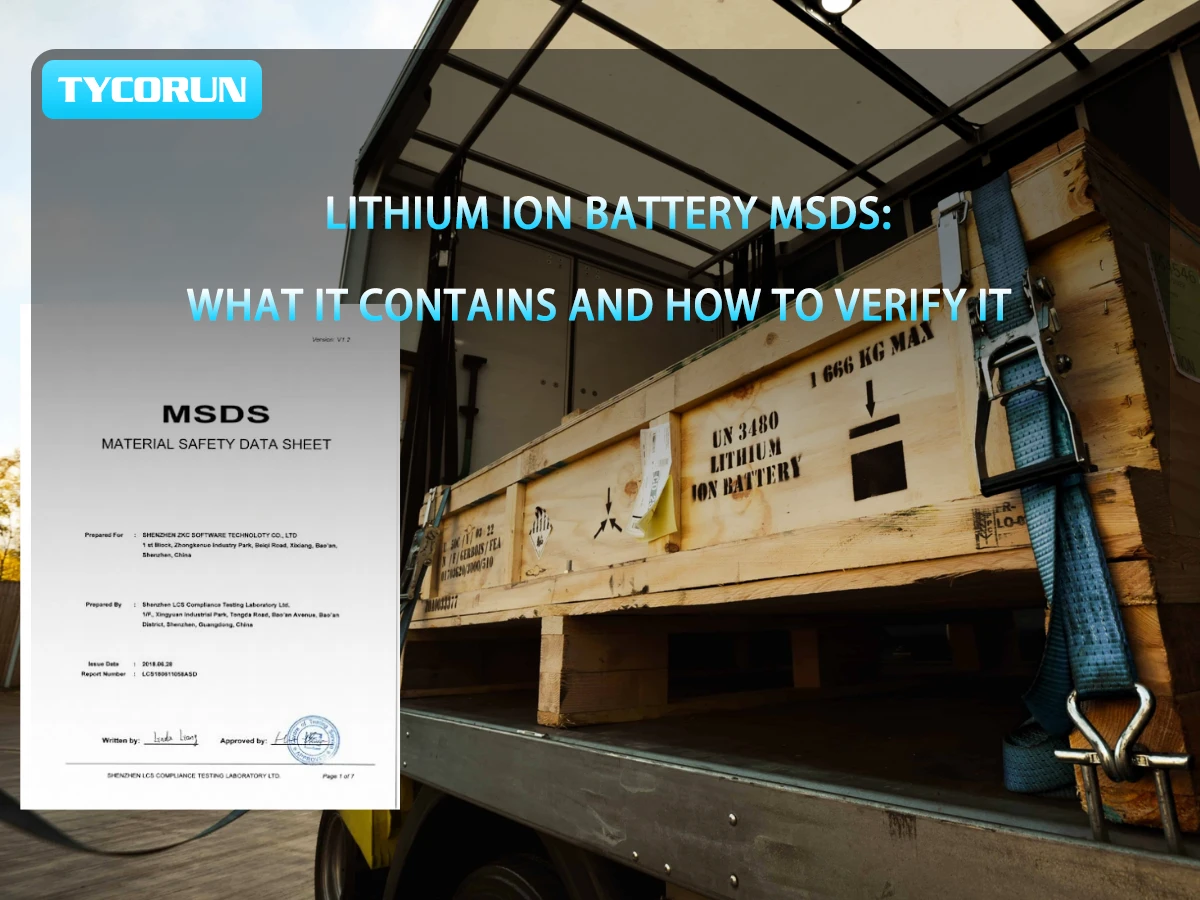
A lithium ion battery MSDS (also written li-ion battery MSDS, and now more commonly called an SDS, or Safety Data Sheet) provides information about a product’s hazards, safe handling, storage, emergency measures, and other safety-related information. The exact requirements for providing an SDS depend on the applicable regulations, product classification, and use; an SDS is not automatically required for every battery in every situation.
For buyers and importers, the more practical question is whether the document actually matches the battery being purchased. A generic MSDS for a similar lithium battery may not be sufficient for a specific battery pack, particularly when the model, chemistry, configuration, or intended use differs.
This guide explains what a lithium battery MSDS/SDS contains, how to check whether it matches the battery, and why additional documentation may still be required.
What Is a Lithium Ion Battery MSDS?
It is a safety data document that explains the battery’s hazards and provides guidance for handling, storage, and emergency response.
“MSDS” is the older term for Material Safety Data Sheet, while SDS is the current terminology used in modern safety-data frameworks such as the EU’s REACH system. The document can help buyers, workers, distributors, and other downstream users understand how the product should be handled and what precautions apply.
An MSDS/SDS should not be treated as a universal battery certification. It also does not replace transport-specific evidence such as the applicable UN38.3 Test Summary.
What Is the Difference Between MSDS and SDS?
MSDS and SDS refer to the same general type of safety document, but SDS is the current terminology.
"MSDS” stands for Material Safety Data Sheet, while “FDS” stands for Safety Data Sheet. Modern regulatory systems such as the EU REACH framework use the term SDS, although buyers and suppliers may still use “MSDS,” which is why the older term remains common in searches and supplier requests.
What Information Does It Contain?
An SDS follows a standardized 16-section structure. Of those sections, Sections 1, 2, 7, 14, and 16 are the quickest to check against the battery in front of you.
| SDS section | Ce qu'il faut rechercher |
|---|---|
| Section 1: Identification | Product name, model or identifier, and supplier/manufacturer |
| Section 2: Hazard identification | Fire, chemical, and other relevant hazards |
| Section 3: Composition | Relevant cell or battery composition information |
| Section 4 and 5: First aid, firefighting | Emergency measures |
| Section 7: Handling and storage | Safe handling, storage conditions, and precautions |
| Section 14: Transport information | Transport-related information provided in the SDS |
| Section 15: Regulatory information | Applicable regulatory references |
| Section 16: Other information | Issue or revision date |
When Is a Lithium Safety Data Sheet Needed?
There is no single worldwide rule that makes an MSDS mandatory for every lithium-ion battery. Whether an SDS must be supplied depends on the jurisdiction, how the product is classified, who is receiving it, and how the battery is used or handled.
In the United States, OSHA’s interpretation of the Hazard Communication Standard for lithium-ion batteries states that when a lithium-ion cell or battery does not qualify for an applicable exemption, the manufacturer or importer may be required to develop an SDS and a compliant label. OSHA also states that hazard classification should consider the product in its shipped form, normal conditions of use, downstream handling, and foreseeable emergencies.
In the EU, ECHA’s guidance on safety data sheets explains that an SDS should be provided for substances or mixtures classified as hazardous under CLP, and for certain other substances and mixtures under specified conditions. Buyers should therefore check the requirements for the specific product and destination market rather than assuming either way.
Even where the law does not require one, an MSDS/SDS is often requested by buyers, distributors, workplaces, and logistics providers as part of their documentation process.
How Do You Verify It?
Before accepting an MSDS from a supplier, check whether the document matches the actual battery.
- Check the manufacturer
The manufacturer or responsible supplier named in the document should be consistent with the company supplying the battery.
- Check the exact product or model
Look for a model number, product name, or other identifier that can be matched to the battery you are purchasing.
- Check the chemistry
Make sure the document corresponds to the actual battery chemistry, such as lithium-ion or lithium iron phosphate (LiFePO₄), rather than a different chemistry.
- Vérifier le configuration de la batterie
A document for an individual cell should not automatically be assumed to describe a finished battery pack. A pack may have a different product identification, voltage, capacity, enclosure, BMS, and configuration.
- Check key electrical information
Compare the battery’s capacity, voltage, and other available product information with the supplier’s specification sheet.
- Check the revision date
An outdated document may not reflect the supplier’s current product or documentation requirements.
- Compare the MSDS with other supplier documents
Compare the MSDS/SDS with the product specification sheet, the battery label, and the applicable transport documentation. Any unexplained mismatch in the model, chemistry, or configuration should be clarified with the supplier before the document is relied upon.
A useful practitioner check is to verify the battery at the finished-pack level as well as the cell level. For example, a 12V 100Ah LiFePO₄ battery has a nominal energy rating of about 1,200Wh. An SDS describing a generic lithium cell may not accurately represent the finished 12V 100Ah pack.
Is an MSDS Enough for Lithium-Ion Battery Shipping?
No. An MSDS/SDS does not by itself establish compliance with all applicable lithium battery shipping requirements.
An SDS provides safety and hazard information, while transport compliance can involve separate requirements for classification, packaging, marking, labeling, documentation, and testing. For how shipments are classified, see our guide to UN3480 vs UN3481 classification.
For air shipments subject to the IATA Dangerous Goods Regulations, the IATA guidance document for lithium batteries (2026) states that lithium-ion batteries shipped by themselves under Packing Instruction 965 must generally be offered at a state of charge of no more than 30%, unless an applicable approval provision applies. The same guidance states that the UN38.3 Test Summary may be made available electronically, including through a website, URL, or QR code.
IEC 62281 is a separate international standard covering transport safety testing for lithium cells and batteries. It does not replace the applicable transport regulations or an SDS.
The practical distinction:
| Document | Objectif principal |
|---|---|
| MSDS/SDS | Safety, hazards, handling, emergency, and related information |
| Résumé des essais UN38.3 | Evidence related to applicable transport testing |
| Fiche technique du produit | Technical product characteristics |
| Documents d'expédition | Shipment-specific dangerous-goods and transport information |
What Should You Request From a Lithium-Ion Battery Supplier?
For a battery purchase, request the documents that apply to the specific product and destination.
A practical supplier document set may include:
- Model-specific MSDS/SDS
- Fiche technique du produit
- UN38.3 Test Summary, where applicable
- Relevant product-safety or conformity documentation
- Shipping documentation, where applicable
The exact document set depends on the product, market, and transport method. Instead of asking only whether the supplier has an MSDS, ask for the document that corresponds to the exact battery model you are purchasing.
What this looks like in practice. For the batteries we ship, the MSDS and the UN38.3 Test Summary are issued for the exact battery model, not for a general product series. We prepare and provide them when booking a shipment, because carriers and freight forwarders require them before they will accept lithium batteries. Some buyers also ask for them earlier, during supplier qualification and before placing an order. In our experience, import customs clearance does not usually require these documents, although some buyers request them for their own warehousing, insurance, or compliance needs, depending on the market.
Common Lithium-Ion Battery Safety Data Sheet Mistakes
- Using a generic or cell-level document for a finished pack. The model, chemistry, and configuration need to match the actual battery.
- Treating the MSDS as a shipping certificate. It does not replace UN38.3 testing, transport classification, packaging, or labeling.
- Ignoring the revision date. An old document may not reflect the supplier’s current product or documentation.
A Practical Example: Checking an MSDS for a Custom Battery
Suppose a buyer orders a 12V 100Ah LiFePO₄ battery from an overseas manufacturer and receives an MSDS, a specification sheet, and a UN38.3 Test Summary.
The first step is not simply to confirm that all three documents exist. The buyer should compare the product identification, manufacturer, chemistry, and battery specifications across them.
The battery’s nominal energy is approximately 1,200Wh (12V nominal × 100Ah; many LiFePO₄ packs are rated at 12.8V nominal, which gives about 1,280Wh). Energy rating matters because it feeds into transport classification. Batteries above 100Wh are generally handled under fuller dangerous-goods requirements than smaller ones, so the Wh figure on the label, the specification sheet, and the shipping documents should all agree. The buyer should also check that the transport documentation reflects the actual finished battery and shipment configuration, rather than a generic cell document.
If the battery will be shipped by air, the buyer should then check the applicable IATA requirements separately. A correct MSDS does not by itself make the shipment compliant.
Questions fréquemment posées
It is a safety data document covering the battery’s hazards, handling, storage, and emergency response. The current term in modern regulatory systems is SDS, or Safety Data Sheet.
Whether it is legally required depends on the market and how the battery is classified, but in practice most buyers, distributors, and logistics providers ask for one. In the US, OSHA’s Hazard Communication Standard may require the manufacturer or importer to prepare an SDS unless an exemption applies. In the EU, an SDS is required for substances and mixtures classified as hazardous under CLP and in certain other cases. Check the rules for your product and destination rather than assuming either way.
It should cover product identification, hazards, handling and storage, emergency measures, transport information, and the other required sections. The exact format and required content depend on the applicable regulatory framework.
No. An MSDS/SDS provides safety and hazard information, while a UN38.3 Test Summary provides information related to applicable transport testing. They serve different purposes.
Only if it corresponds to your actual product. Before relying on one, check the manufacturer, model, chemistry, battery configuration, and other product information against the battery and its specification documents.
No. Shipping compliance depends on the applicable dangerous-goods and transport rules, including classification, packaging, marking, labeling, documentation, and testing requirements. An MSDS provides supporting safety information, but it does not replace the applicable transport documentation.
The manufacturer or responsible supplier is the appropriate starting point for obtaining the product's safety documentation. Buyers should request the document directly from the supplier and verify that it corresponds to the exact battery being purchased. Under OSHA's Hazard Communication framework, the manufacturer or importer is responsible for determining whether the product presents a physical or health hazard to workers.
Conclusion
Before relying on a lithium battery MSDS/SDS, request the model-specific document from the supplier and check it against the actual battery: manufacturer, model, chemistry, configuration, and key specifications. Then confirm separately whether your market or shipment needs additional documents.
If you are sourcing a custom battery pack, ask for the MSDS, specification sheet, and UN38.3 Test Summary together, so you can cross-check all three against the same model before you place an order. You can discuss your requirements with our team to see what documentation comes with each batch.

Les normes UN38.3, CEI 62133-2 et le marquage CE répondent à des objectifs de conformité différents. Ce guide explique ce que couvre chacune d'entre elles, quels documents demander et comment vérifier la conformité des batteries au lithium avant leur expédition ou leur importation.

La norme UN3480 s'applique aux batteries lithium-ion expédiées seules, tandis que la norme UN3481 concerne les batteries emballées avec ou installées dans des équipements. Ce guide 2026 explique comment la configuration d'expédition détermine les instructions d'emballage (PI965/966/967), les étiquettes, les limites d'état de charge et la documentation, et comprend une liste de contrôle pratique à l'intention des importateurs pour une expédition conforme des batteries au lithium.

Les éléments à vérifier avant de choisir un fournisseur de batteries, de l'inspection en ligne du revêtement et des tests d'étanchéité aux certifications, en passant par la manière d'interpréter les allégations relatives à la durée de vie.
Auteurs
-
Voir tous les messages
Audrey Chloe est une autrice et chercheuse spécialisée dans les technologies de stockage d'énergie, qui s'intéresse tout particulièrement aux batteries lithium-ion, aux systèmes de gestion de batterie (BMS) et à leur utilisation concrète dans les vélos électriques, les véhicules électriques et le stockage d'énergie domestique. Forte d'une formation en science des matériaux, elle étudie comment la chimie des batteries, leur conception et leurs modes d'utilisation influencent leurs performances, leur sécurité et leur durée de vie.
Son objectif est de transformer les concepts complexes des batteries en idées claires et pratiques qui aident les gens à prendre des décisions éclairées sur les technologies énergétiques de tous les jours.
-
Voir tous les messages
Meg est ingénieur en batteries et possède plus de 10 ans d'expérience dans le secteur du stockage de l'énergie. Elle est titulaire d'une licence en génie électrique et a travaillé auparavant comme ingénieur R&D chez un fabricant de batteries lithium-ion, où elle s'est concentrée sur les systèmes de gestion des batteries (BMS), les algorithmes de charge et les tests de cycle de vie pour les batteries plomb-acide, AGM et lithium. Elle a contribué au développement des technologies de maintenance des batteries utilisées dans les produits commerciaux. Meg assure aujourd'hui la révision technique du contenu relatif au stockage de l'énergie afin de garantir l'exactitude, la sécurité et la valeur pratique pour les lecteurs.