Last Updated on octobre 16, 2026
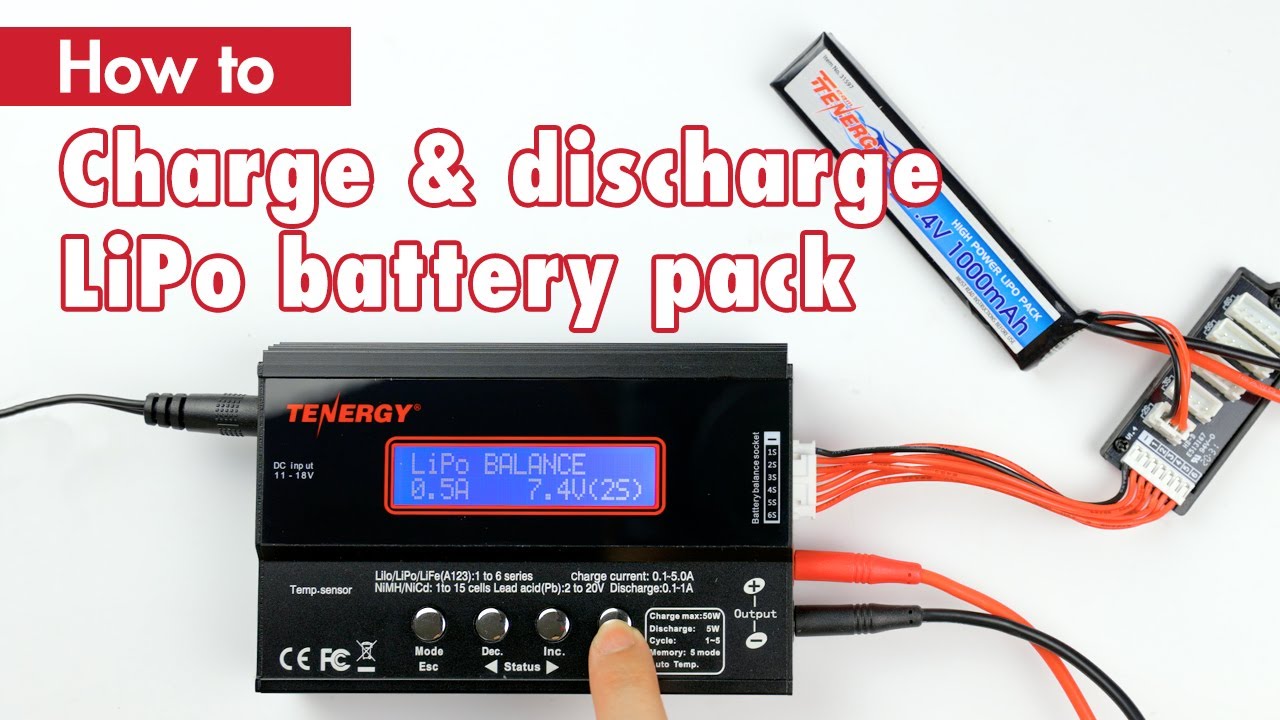
To charge a LiPo battery, use a charger set to LiPo mode, match the cell count (S) to the battery label, set the charge current to 1C or lower, connect the balance lead on multi-cell packs, and stay with the battery until charging ends. A fully charged LiPo cell reads 4.2V.
This guide walks through the full process: what to check on the battery, what equipment to use, the charging steps, what to do on the first charge, and the mistakes that most often damage cells.
| Objet | Typical value for standard LiPo |
|---|---|
| Nominal voltage per cell | 3.7V |
| Full charge voltage per cell | 4.2V |
| Courant de charge | 1C or lower (a 2000mAh battery is charged at 2A or less) |
| Méthode de chargement | Constant current, then constant voltage (CC/CV), with balance charging |
| Charger mode | LiPo (not NiMH, NiCd or Li-ion modes) |
| Storage voltage | About 3.8V per cell |
| Charging temperature | Commonly about 0°C to 45°C, check the cell datasheet |
Some high-voltage cells (LiHV) are charged to 4.35V per cell. Only use that setting if the battery is clearly labeled as LiHV.
Know Your LiPo Battery Before Charging
A LiPo (lithium polymer) battery, sometimes written as Li-Po or li polymer battery, is a lithium-ion battery that uses a polymer electrolyte, usually in a thin, flexible pouch. Most commercial LiPo cells use a gel polymer electrolyte. The charging rules below apply to both single cells and multi-cell packs.
Before you connect anything, read the label and note these four things:
- Cell count (S). The “S” number is how many cells are wired in series. It decides the voltage and the charger setting.
- Capacity (mAh). This sets the charge current. Divide mAh by 1000 to get the 1C current in amps.
- C rating. The C rating usually describes the battery’s discharge capability. It is not automatically its safe charge rate. Use 1C unless the manufacturer specifies a higher maximum charge current.
- Packs normally have a main power connector (such as XT60 or Deans) and, on multi-cell packs, a balance connector (often JST-XH). The charger must match both.
The model code printed on small pouch cells often shows the size. For example, 654065 typically means about 6.5mm thick, 40mm wide and 65mm long. It does not tell you the charging settings.
| Cell count | Tension nominale | Full charge voltage |
|---|---|---|
| 1S | 3.7V | 4.2V |
| 2S | 7.4V | 8.4V |
| 3S | 11.1V | 12.6V |
| 4S | 14.8V | 16.8V |
| 6S | 22.2V | 25.2V |
What You Need to Charge a LiPo Battery
- A LiPo balance charger with a LiPo mode and a balance port that matches your pack
- A suitable power supply, if the charger does not have a built-in one
- Cables and adapters that match your battery connectors
- A LiPo safe bag or a fire-resistant container
- A non-flammable surface to charge on, away from paper, fabric and other flammable items
- A voltage checker or cell monitor (optional, but useful for checking each cell)
A phone charger, a USB adapter or a charger meant for another battery type is not a substitute. LiPo cells need a charger that controls both current and voltage per cell.
How to Charge a LiPo Battery: Step by Step
- Inspect the battery. Look for swelling, dents, punctures, torn wrapping, damaged wires or a burnt smell. A damaged battery should not be charged.
- Let it cool. If you just used the battery, wait until it is at room temperature before charging.
- Set up a safe charging spot. Place the battery in a LiPo bag or fire-resistant container on a non-flammable surface, away from flammable materials.
- Connect the battery to the charger. Attach the main lead, then the balance lead if the pack has one. Check that connector types and polarity match.
- Select the mode. Choose LiPo, and use the balance charge mode for multi-cell packs. Other chemistry modes can overcharge a LiPo cell.
- Set the cell count. Match the S setting to the battery label. Most chargers show the detected voltage, so confirm it fits the cell count you selected.
- Set the charge current. Use 1C or lower unless the battery datasheet specifies a different maximum charge current. For example, a 2000mAh battery is charged at 2A or less at 1C.
- Start charging and stay with it. Check the battery from time to time. If it becomes noticeably hot, swells, hisses or smells, stop charging and move on to the safety steps below.
- Finish and disconnect. When the charger signals the end of charge, disconnect the battery and let it rest before use or storage.
What to Check on the First Charge
A new battery needs a few extra checks:
- Inspect it on arrival for swelling, damaged wrapping or loose wires.
- Measure the voltage per cell. New batteries often arrive near storage voltage, about 3.8V per cell, but this varies by supplier.
- Confirm the cell count against the label and the charger display.
- Charge at 1C or lower, and stay present for the whole charge.
- If any cell reads far below the normal range, or the pack looks swollen, do not charge it. Contact the supplier instead.
There is no need to use unusual settings for a first charge. The same rules apply as for every later charge.
Charge Current and Charging Time
The 1C rule is the usual starting point: the charge current in amps equals the battery capacity in amp hours.
| Capacité de la batterie | 1C charge current |
|---|---|
| 1000mAh | 1A |
| 2000mAh | 2A |
| 5000mAh | 5A |
Some cells are rated for faster charging, and the datasheet is the only reliable source for that. A lower current, such as 0.5C, puts less stress on the cell and is generally gentler on battery life, but it takes longer.
Charging time depends on the starting charge and the current. As a rough guide, a low battery charged at 1C often needs about 1 to 1.5 hours, because the current tapers off during the constant voltage stage. At 0.5C, expect about 2 to 3 hours.
Common LiPo Charging Mistakes
- Wrong charger or mode. NiMH or Li-ion modes use different voltage limits and can overcharge a LiPo cell.
- Wrong cell count. Setting the wrong S value gives the wrong target voltage.
- Skipping the balance lead. On multi-cell packs, cells can drift apart in voltage when they are not balanced.
- Charging current above the rating. Faster charging adds heat and wear unless the cell is specified for it.
- Charging a damaged or swollen battery. Physical damage raises the risk of internal short circuits.
- Charging a hot battery. Let it cool first.
- Leaving it unattended. Heat or swelling needs to be noticed early to be handled safely.
- Charging on or near flammable items. Use a LiPo bag and a non-flammable surface.
- Leaving the battery fully charged for long periods. This accelerates wear. Charge close to the time of use.
After Charging: Use It or Store It
If you will use the battery soon, disconnect it and let it rest. If you will not use it for days or weeks, discharge or charge it to about 3.8V per cell and keep it in a cool, dry place. The LiPo storage voltage guide explains how to set storage mode and what voltage range to target.
If a battery swells, gets unusually hot or is physically damaged, stop using it. Keep it on a non-flammable surface away from flammable items, and take it to a battery recycling point. Do not puncture or squeeze it.
Looking for LiPo Cells for Your Own Product?
If you’re developing a device and looking for reliable LiPo cells, TYCORUN supplies lithium polymer pouch cells in standard sizes, such as the 654065 3.7V 2000mAh lithium polymer battery. For a specific size, capacity or connector, see our custom lithium ion battery solutions ou contactez notre équipe with your requirements.
Questions fréquemment posées
No. Use a charger with a LiPo mode that controls current and voltage per cell. Chargers made for other battery types, and most USB or phone chargers, do not control cell voltage the way a LiPo needs, so they can overcharge the battery. For multi-cell packs, choose a balance charger that matches your balance connector.
Roughly 1 to 1.5 hours at 1C for a low battery, and longer at lower currents. The current tapers as the cells approach 4.2V, so the last part of the charge is slower. A 2000mAh battery charged at 2A is a typical example. Starting from a partly charged battery shortens the time.
For multi-cell packs, balance charging is the recommended method. It keeps each cell at the same voltage so no single cell is pushed above 4.2V. A single-cell (1S) battery has no balance lead, so a standard LiPo charge mode is used.
Charging should be supervised. Any fault, swelling or heat is easiest to catch when you are present. If you need a longer charge window, use a lower current so that charging finishes while you are nearby.
Overcharging stresses the cell and can cause swelling, heat, permanent capacity loss and, in serious cases, fire. Going above 4.2V per cell for standard LiPo pushes the cell beyond its design limit. A quality charger stops at the correct voltage, which is why the right mode and cell count settings matter.
Charge it at room temperature where possible. Many LiPo cells specify a charging range of about 0°C to 45°C, so a cold battery should be brought to room temperature first. Charging below the specified range can damage the cell. Check the datasheet for your battery's exact limits.
Only if the manufacturer explicitly states that the cell or pack supports 2C charging. Many standard LiPo cells are designed for 1C or lower charging; charging above the specified rate can increase heat, accelerate aging and raise safety risks. Check the datasheet before using a faster charge setting.

Dans cet article, nous verrons en détail comment charger une batterie à électrolyte gélifié de 12 volts. Nous commencerons la discussion par une meilleure compréhension des batteries à électrolyte gélifié, les outils à préparer, les étapes de recharge, les conseils de charge et le dépannage des problèmes de charge.

C'est pourquoi, dans cet article, nous examinerons en profondeur ce qu'est l'optimisation de la batterie et sa fonction dans les systèmes électriques. Nous commencerons la discussion par les principes de base, la technique et la stratégie, les outils et la technologie de soutien, son impact, ses défis et ses solutions.

Dans cet article, nous examinerons en détail le fonctionnement d'un chargeur de batterie et la manière dont le processus peut être exécuté de manière sûre et efficace.
Auteurs
-
Voir tous les messages
Anastasia est une chercheuse spécialisée dans les énergies renouvelables et une rédactrice technique spécialisée dans les onduleurs, les solutions de stockage d'énergie domestique et les tendances en matière d'énergie propre. Dotée d'un sens aigu de l'analyse du marché et de l'évolution de l'industrie, elle transforme des concepts techniques complexes en informations exploitables et faciles à comprendre. Son objectif est de permettre aux propriétaires et aux entreprises de prendre des décisions en toute connaissance de cause en ce qui concerne le déploiement de l'énergie durable.
-
Voir tous les messages
Meg est ingénieur en batteries et possède plus de 10 ans d'expérience dans le secteur du stockage de l'énergie. Elle est titulaire d'une licence en génie électrique et a travaillé auparavant comme ingénieur R&D chez un fabricant de batteries lithium-ion, où elle s'est concentrée sur les systèmes de gestion des batteries (BMS), les algorithmes de charge et les tests de cycle de vie pour les batteries plomb-acide, AGM et lithium. Elle a contribué au développement des technologies de maintenance des batteries utilisées dans les produits commerciaux. Meg assure aujourd'hui la révision technique du contenu relatif au stockage de l'énergie afin de garantir l'exactitude, la sécurité et la valeur pratique pour les lecteurs.