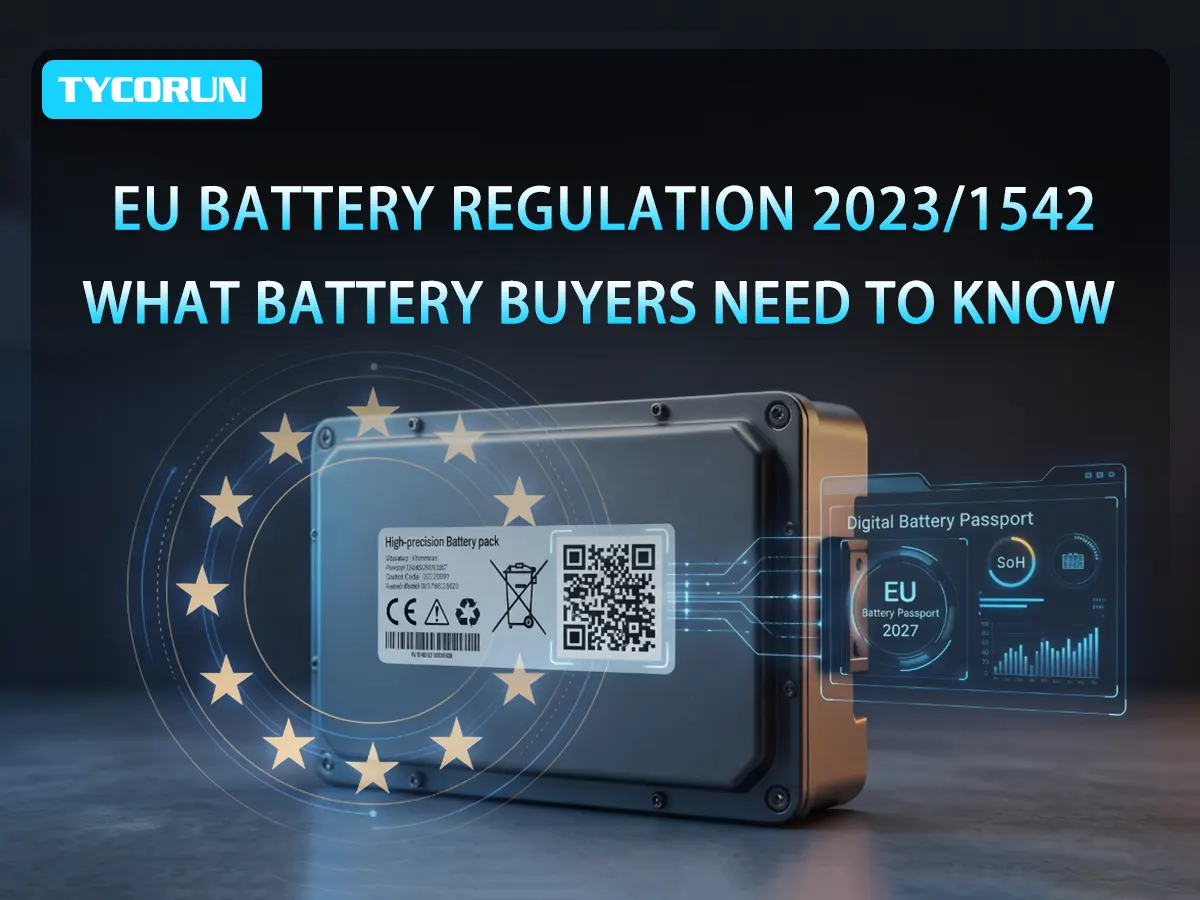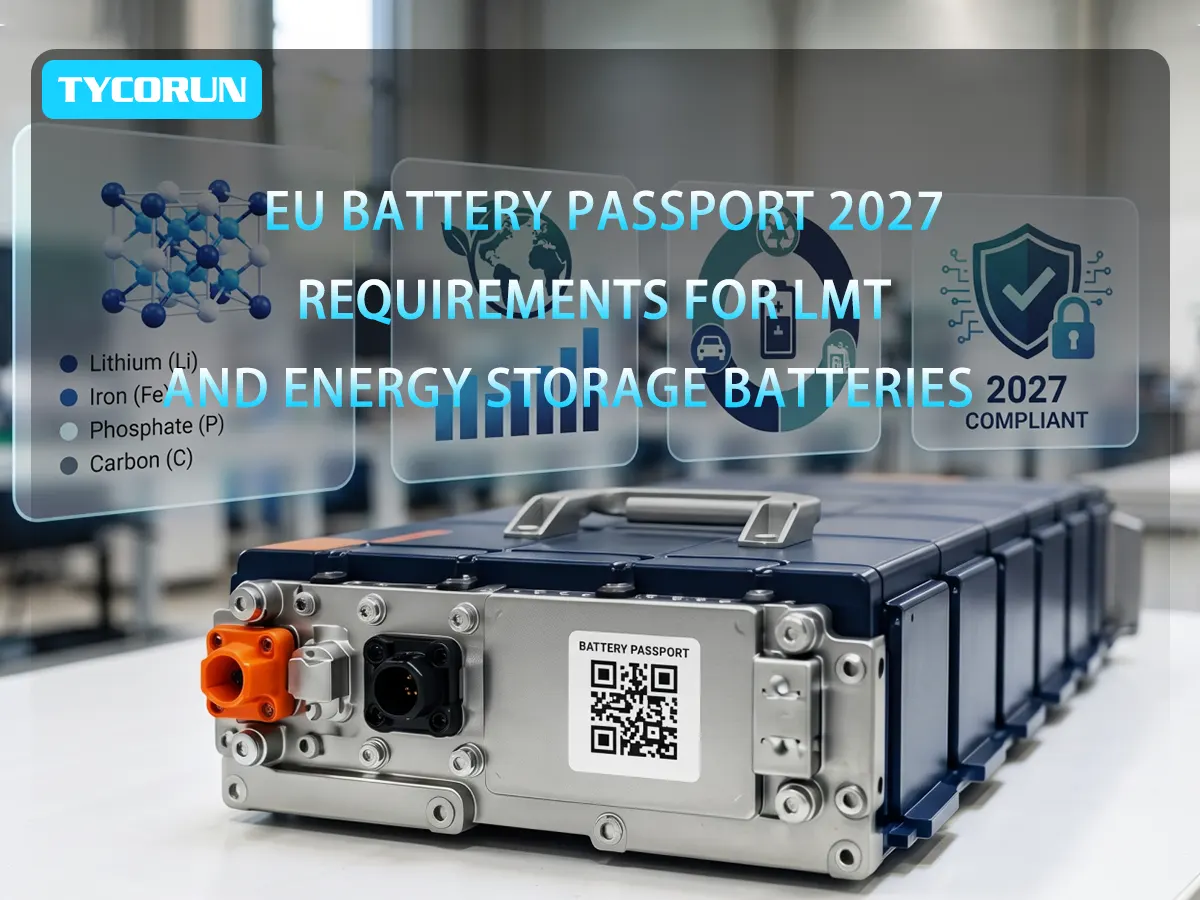
From 18 February 2027, every LMT battery, every EV battery and every industrial battery above 2 kWh placed on the EU market needs a battery passport. It is a digital record for each individual battery, opened by scanning the QR code on the pack. It shows what the battery is, who made it, what it contains, how it has performed and how to recycle it.
For importers and OEMs buying packs for e-bikes, e-scooters, e-mopeds and light e-motorcycles (the LMT category), the passport applies at any capacity. For stationary energy storage, the line is 2 kWh. This guide explains which batteries need a passport, what the record contains, who is responsible, and what to ask your battery manufacturer for.
What Is the EU Battery Passport?
The battery passport combines two kinds of data. Static data is set at manufacture: identifiers, chemistry, bill of materials, certificates and recycled content. Lifecycle data has to be kept up to date over the battery’s life: state of health and status changes such as repurposing.
It is the first digital product passport the EU is making mandatory, and it is meant to connect with the wider Digital Product Passport system being built under the ecodesign rules.
The passport is one part of a larger law that also covers CE marking, labelling, carbon footprint, recycled content and due diligence. For the full picture, start with our guide to the EU battery regulation.
Does the passport require a permanent connection?
The EU regulation does not mandate an around-the-clock cellular connection. While lifecycle data must remain current, update mechanisms depend on pending implementing acts. At the design phase, the core engineering requirement is ensuring your battery management system (BMS) can log and export the necessary health and telemetry data.
Which Batteries Need a Battery Passport?
Under Article 77(1), three categories need a passport from 18 February 2027:
- LMT batteries, for light means of transport such as e-bikes, e-scooters, e-mopeds and light e-motorcycles. There is no minimum capacity, so even the smallest e-bike pack is in scope.
- Industrial batteries above 2 kWh, which includes most stationary energy storage systems above that size, as well as motive power packs for forklifts and similar equipment.
- Electric vehicle batteries, for cars, vans, trucks, buses and heavier L category vehicles.
Two categories do not get a passport. Portable batteries (consumer electronics, power tools, small appliances) are outside it, although the Commission is to assess whether the scheme should be extended to them later. SLI batteries, used for engine starting, lighting and ignition, are also outside it.
Stationary energy storage deserves a closer look. The regulation defines a stationary battery energy storage system as an industrial battery with internal storage, so systems above 2 kWh fall in the passport track. Whether a multi pack system counts as one battery or several is decided case by case, so confirm it with your compliance advisor.
Do not confuse the passport with the QR code. From the same date every battery on the EU market needs a QR code, including portable and SLI batteries. On an LMT, EV or larger industrial battery, scanning it opens the passport. On any other battery it opens simpler labelling and conformity information.
When Does the Passport Apply?
The mandatory date is 18 February 2027, set in Article 77(1). In the current consolidated text that date is unchanged, although other obligations, such as supply chain due diligence, have been postponed. Several details of the passport still depend on acts that are being adopted, so check the official sources again before you fix your launch plans.
Phased Data and No Retroactive Enforcement
The record is phased in. The Commission’s August 2026 guidance brings together 71 data points for EV, LMT and industrial batteries and marks which fields are not required when the passport starts in February 2027. Some carbon footprint fields follow later timetables, such as August 2028 for LMT batteries. A passport at launch therefore contains the mandatory starting data set, not the eventual full record.
The obligation is triggered when a unit is first placed on the EU market, not by its manufacturing date. A battery first placed on the market before 18 February 2027 does not need a passport, even if it is sold on later. Keep customs and batch records as evidence of the first placement date, because market surveillance authorities can ask for them.
Battery Passport Requirements: What the Record Contains
Annex XIII organises the data by who may see it. Not everything is public, and some of the more sensitive fields are restricted. Part of the access rules, in particular for parties with a legitimate interest, is still to be set by an implementing act, so the table shows what is fixed and what is not.
| Data group | Who can access it | Examples |
|---|---|---|
| Open to the general public | Anyone who scans the QR code | Basic identification, manufacturer details, chemistry and general composition, carbon footprint information, recycled and renewable content, capacity, voltage, expected lifetime, the EU declaration of conformity, waste handling guidance |
| Restricted to authorities and conformity bodies | Notified bodies, market surveillance authorities, the Commission | Underlying test report results and conformity evidence |
| Detailed model information | Parties with a legitimate interest. The exact access rules are still to be defined | Detailed material composition, component part numbers, dismantling and removal information, spare part sources, safety measures during disassembly |
| Battery level data | Parties with a legitimate interest. The exact access rules are still to be defined | State of health, remaining capacity and power capability, round trip efficiency, self discharge, internal resistance, charge history, negative events, status (original, reused, repurposed, remanufactured, waste) |
The passport carries a unique identifier and has to stay available even if the responsible operator leaves the EU market. When a battery is recycled the record is closed. When it is repurposed or remanufactured, a new passport is created and linked to the original.
QR Code, Identifier and Data Standards
The QR code is the data carrier, and each passport has a unique identifier behind it. Technical standards for both are still being developed through European standardisation work. In practice, suppliers and platform providers often refer to ISO/IEC 15459 for identifier structure and GS1 Digital Link for QR code resolution, and the Battery Pass consortium has published content and technical guidance that many projects use as a reference. These are reference points, not confirmed legal requirements, so ask your supplier and platform provider which approach they plan to use.
Who Must Create and Maintain the Passport?
The legal duty sits with the economic operator that places the battery on the EU market or puts it into service. That operator assigns the unique identifier behind the QR code, keeps the record accurate and up to date, and registers the identifier in the EU digital product passport registry, which the Commission opened for testing in July 2026. Three points matter in practice:
- Creating the record and registering it are two separate acts. Building the data record is not the same as registering its identifier, and both are required. Confirm in your contract who does each one.
- The work can be delegated, the responsibility cannot. Under Article 77(4), the responsible operator can authorise a manufacturer, a cell maker or an OEM in writing to create and update the passport on its behalf. The authorisation does not transfer ultimate legal responsibility. The operator placing the battery on the market stays accountable for the accuracy of the data.
- For a finished pack, the battery maker is usually the responsible manufacturer. According to the Commission’s guidance, if a complete, finished battery is supplied to a vehicle maker who only installs it, the battery maker is responsible. If the vehicle maker completes the battery, for example by adding the BMS, responsibility moves to the vehicle maker. Where the battery maker is outside the EU, the EU importer carries the obligations of the manufacturer.
Keep batch level and shipment records long enough to support an audit, and confirm the retention period with your importer. A manufacturer whose data process ends at the shipping note will struggle to support a passport that has to be kept current.
What Buyers Should Ask Manufacturers to Provide
Most of the passport is assembled from data only the factory holds, so the handover between manufacturer and buyer is the most important compliance document in the relationship. Some data a well run manufacturer can supply for any model. Other items depend on how the project is set up, or on rules that are still being finalised.
| Ask your supplier for | May depend on project setup or pending rules |
|---|---|
| Battery and cell identifiers, model, batch and serial numbers, manufacturer and plant details, manufacturing date and place | How the unique identifier is generated and linked to the QR code on the pack |
| Chemistry and bill of materials, hazardous substance declarations, critical raw materials | Verified carbon footprint declaration per model and plant (for LMT batteries from August 2028 or later) |
| Rated capacity, voltage, energy, weight, expected cycle life, and the test data behind them | Audited recycled content figures (minimums start in 2031 for the first categories, later for LMT) |
| Safety and transport evidence: UN38.3 and IEC 62133 reports, the lithium-ion battery MSDS, the EU declaration of conformity | Dismantling manuals, spare part references and safety procedures formatted for the restricted access tiers |
| Batch level traceability and a named contact for data questions | A state of health feed from the battery management system into a passport platform, the written authorisation with the importer, and registry registration |
Be cautious of any vendor claiming “100% full-field compliance tomorrow.” Several data standards and secondary acts are still being finalised. A supplier that is ready for audit will separate what is test-ready today (chemistry and bill of materials, IEC safety certificates) from what depends on the 2027 and 2028 roadmap.
Planning an EU launch for LMT or storage packs? Talk to TYCORUN’s engineering team about BMS state of health data output and what your passport platform needs from the pack. Contact engineering.
Practical Steps Before February 2027
- Classify every product. Confirm whether each battery is LMT, industrial above or below 2 kWh, EV, portable or SLI. The category decides whether you need a passport or only the QR code and labels.
- Identify the responsible operator. Agree in writing whether your EU entity, your importer or an authorised representative places the battery on the market, and who is named as passport operator.
- Check your supplier’s data readiness. Ask for the left column of the table above for each model, and a dated commitment for the items in the right column. Treat missing test reports and traceability as blockers.
- Plan the QR code and identifier. Confirm how the identifier is generated, where the code is placed on the pack, and which platform will host the record.
- Plan the BMS data link early. Battery level data cannot be assembled by hand at scale, so specify the BMS data interface and update process during product design.
- Keep first placement evidence. Keep batch level records showing which units entered the EU before the deadline, so older stock is not pulled into the obligation by mistake.
- Treat the UK separately. Great Britain follows its own older regime for now, while Northern Ireland follows the EU rules under the Windsor Framework.
Frequently Asked Questions
Yes. E-bike batteries are LMT batteries, and every LMT battery placed on the EU market from 18 February 2027 needs a passport at any capacity, together with the QR code. There is no exemption for small packs.
It depends on capacity. Stationary energy storage systems are industrial batteries, and those above 2 kWh need a passport. Smaller units still need CE marking, labels and the QR code, but the code opens conformity and labelling information rather than a passport. For multi pack systems, check with your compliance advisor whether the system counts as one battery.
No. The QR code is required on every battery from February 2027, but it only opens a passport on LMT, industrial above 2 kWh and EV batteries. On portable and SLI batteries it links to simpler product and waste information.
The regulation does not say every battery must be online around the clock. Lifecycle data has to be kept current, but how and how often it is updated depends on the final implementing rules. Specify the BMS data output during product design and confirm the update process with your compliance advisor.
The operator that places the battery on the EU market, which is usually the EU importer when the manufacturer is outside Europe. That operator can authorise the overseas manufacturer in writing to build and update the passport, but responsibility for the accuracy of the data stays with the importer. Where a finished battery is only installed by a vehicle maker, the battery manufacturer remains the responsible operator.
Not in Great Britain, where the older UK batteries regulations still apply and there is currently no battery passport requirement. The UK Government has been looking at digital product records more broadly, including through a 2026 call for evidence. The passport does apply in Northern Ireland under the Windsor Framework. Treat EU and Great Britain shipments as two separate compliance regimes.
In general, the obligation is not retroactive. A battery first placed on the EU market before 18 February 2027 does not need a passport, even if it is sold on later. Keep batch level evidence of the first placement date, because market surveillance authorities can ask for it. A battery that is remanufactured after the deadline may need a new passport.
The operator that places the repurposed or remanufactured battery back on the market takes over responsibility and creates a new passport linked to the original. The record is closed when the battery is finally recycled.
This guide is a summary for procurement planning, based on the EU Batteries Regulation and the Commission’s August 2026 data points guidance. It is not legal advice. Some data fields and access rights depend on implementing acts still being adopted, so confirm the current position with your importer, notified body or compliance advisor.
Sources
- EU Digital Product Passport FAQ for Batteries, European Commission
- Digital Batteries Passport Data Points Guidance v2.0 (August 2026) [PDF], European Commission
- Digital Product Passport for Batteries & DPP Registry Overview, European Commission
- Regulation (EU) 2023/1542 (Article 77 & Annex XIII Consolidated Text), EUR-Lex
- EU Batteries Regulations in Northern Ireland (Windsor Framework Guidance), GOV.UK
- Call for Evidence: Digital Product Record Policy, GOV.UK

UN3480 applies to lithium-ion batteries shipped by themselves, while UN3481 covers batteries packed with or installed in equipment. This 2026 guide explains how the shipping configuration determines packing instructions (PI965/966/967), labels, state-of-charge limits, and documentation, and includes a practical importer checklist for compliant lithium battery shipping.

The battery manufacturing date indicates when a battery was produced, helping you assess its age, freshness, and suitability for use. This guide covers how to locate the date code, decode various formats, and understand its impact on warranty and buying decisions.

Discover the top 10 Japanese battery brands and manufacturers in 2026, from Panasonic and GS Yuasa to Toyota Battery and Murata. Explore their innovations in EV, consumer electronics, and industrial energy storage.
Authors
-
View all posts
Ryder is a hands-on lithium battery specialist and technical content author with over five years of deep field experience in electric mobility infrastructure. He specializes in cell testing, pack diagnostics, and real-world Battery Management System (BMS) performance analysis. Having collaborated closely with top-tier R&D teams, Ryder excels at evaluating battery safety against stringent global standards like UN38.3 and IEC 62133. Through his articles, he aims to eliminate marketing noise, offering readers raw, data-driven insights into battery safety, performance, and lifespan optimization.
-
View all posts
Meg is a battery engineer with 10+ years of experience in the energy storage industry. She holds a B.S. in Electrical Engineering and previously worked as an R&D engineer at a lithium-ion battery manufacturer, where she focused on battery management systems (BMS), charging algorithms, and life-cycle testing for lead-acid, AGM, and lithium chemistries. She has contributed to the development of battery maintenance technologies used in commercial products. Meg now provides technical review for energy storage content to ensure accuracy, safety, and practical value for readers.