Understanding Battery SoC: How It Works and Why It Matters

In this article, we will explain battery SOC, from how to maintain it, the factors that affect it, and how to calculate it.

Author :

Reviewers:

understanding battery soc

Measuring battery performance and efficiency is important for lithium-ion batteries that we use for many applications. One of the key metrics used to measure that is the Battery SoC (State of Charge). Understanding SoC in battery is really important to maximize battery life, ensure safety and efficiency of your battery, and know how to prevent unexpected power loss. In this article, we will explain what is SoC meaning in battery, from how to maintain it, the factors that affect it, and how to calculate it. 

 
Table of Contents
    Add a header to begin generating the table of contents
    YouTube_play_button_icon

    Battery SoC (State of Charge) Meaning

    Battery SoC refers to the current charge level of a battery relative to its maximum capacity. SoC in battery is usually mentioned using percentage, with 100% indicating the fully charged battery and 0% for when it’s fully discharged.

    SoC is an important parameter in BMS (Battery Management System) that is shown to help users monitor the battery usage and help them to maintain battery health too. Various battery voltage, battery weight, and battery applications, such as in smartphones, laptops, electric vehicles, and energy storage rely on SoC measurement to maintain battery efficiency and lifespan.

    SoC in battery is important for its ability in providing real-time insights of battery performance. This will be helpful for us to prevent overcharging or deep discharging, because these two factors will fasten battery degradation and shorten the battery lifespan.

    Accurate SoC measurement is important in electric vehicles, because it will impact driving range and the user needs to prepare enough battery if they want to use the vehicles for a long ride. In an energy storage system, SoC in battery is also important so that we can ensure optimal energy distribution and maximize its efficiency.

    There are several ways to determine and calculate battery SoC, such as voltage-based estimation or using machine learning algorithms to analyze usage habits. However, there are different factors that can affect its measurement, such as battery aging and temperature. But, if we choose a battery with advanced battery management technology, usually the manufacturers have accurate SoC estimation to ensure their battery is efficient and reliable.

    How to Maintain Battery SoC?

    how to maintain battery soc

    Maintaining optimal SoC is important for longer battery life and efficient performance. Here are some best practices you can do to maintain it:

    Avoid Extreme Charge Levels

    Keep it between 20% and 80% because this is an optimal range. Doing this will reduce stress on the battery and extend its lifespan and keep capacity retention in check. Avoid full discharges or overcharging which can lead to deep cycling and in severe cases could end up with dead battery.

    Manage Temperature

    Temperature is important for battery health. Extreme temperature, whether it’s hot or cold, will cause capacity loss, reduce battery efficiency, and lead to potential safety risks. Use battery fuse for safety and store your battery in the right temperature conditions to maintain battery SoC.

    Avoid Long-term Storage at Full or Empty Charge

    If you plan to store a battery for a long period, you should keep it at partial charge rather than 100% or 0%. Storing in a fully charged or completely depleted battery condition will fasten battery degradation and reduce battery health.

    Use Battery Management Systems (BMS)

    Choose the battery from a high-quality manufacturer which has an advanced battery management system like TYCORUN. BMS allows users to do real-time tracking of battery SoC levels and provide recommendations on how to maintain battery health. Knowing this information will help you to take preventive actions before battery performance declines.

    Factors Affecting Battery SoC

    factors affecting battery soc

    There are several factors that influence the SoC in batteries. Knowing these factors will help you optimize battery performance and maintain its lifespan. Below are some of the key elements that impact SoC:

    Temperature Variations

    High temperature can cause faster battery degradation, while cold temperatures reduce overall efficiency. That is why it’s important to maintain the right temperature for your battery.

    Battery Aging

    Battery capacity can decline due to natural usage. When the battery ages, the ability to hold charge also decreases, and SoC estimation that we see is also less accurate, leading to reduced battery performance.

    Discharge Rate

    High discharge rate will cause voltage drops which lead to inaccurate SoC measurements. This might be inconvenient for users who require more precise SoC monitoring like in high-power applications.

    Battery Chemistry

    Different battery types such as lead acid, AGM, and lithium-ion have specific characteristics that impact SoC measurements. Each battery type is different in charge and discharge rate, and it could lead to more stable or larger fluctuations in SoC readings.

    Battery SoH (State of Health)

    SoH refers to the overall condition of a battery which directly impacts SoC. An old and degraded battery has lower SoH, therefore it may display inaccurate SoC measurements because of its reduced capacity and efficiency. There are several tips that you can do to maintain battery SoH, such as regular maintenance and monitoring battery usage with BMS.

    How to Calculate Battery SoC?

    how to calculate battery soc

    SoC calculations are methods that we used to know the available capacity of the battery. There are several techniques to do this, and some might seem very technical to general battery users. From direct and open measurements to mathematical methods, each approach has its own advantages and limitations.

    Coulomb Counting

    This method calculates battery SoC by tracking the charge entering and leaving the battery over time. The system will estimate the remaining capacity by integrating the current flow. This approach requires an initial calibration and is considered one of the most accurate methods, but the accuracy may decline over multiple charge cycles.

    Voltage-based Measurement

    One of the easiest ways to estimate SoC is measuring it based on battery voltage. This method is not very technical, but also not very reliable because voltage fluctuates a lot, based on load and temperature conditions. This is useful for rough estimation but we can’t use it to provide precise reading of battery SoC.

    Open Circuit Voltage Measurement

    OCV method estimates SoC by measuring the battery voltage when it’s at rest. By using the battery’s open circuit voltage, this method utilizes voltage vs SoC relationship to know the charge level. The OCV method could vary between different battery types and requires a reference chart for better and accurate reading.

    SoC of Different Types of Battery

    Different battery chemistries have different charge and discharge characteristics, which affects how their SoC is maintained and measured. Here is an overview of SoC ranges for several battery types

    Lithium-ion Battery SoC

    LITHIUM-ION BATTERY SOC

    Lithium-ion battery are widely used in the modern world because of their versatility. We found it in consumer electronics, electric vehicles, and energy storage systems. This type of battery has stable voltage during discharge and offers high energy density.

    Lead Acid Battery SoC

    LEAD-ACID BATTERY SOC

    Nowadays, lead-acid batteries are commonly used in automotive applications and backup power systems. This type of battery can be a choice for those who news cost-effective solutions, even though they have lower energy density compared to lithium battery types.

    AGM Battery SoC

    AGM BATTERY SOC

    AGM (Absorbent Glass Mat) is the type of battery that uses fiberglass mats to absorb electrolytes. This battery can be used for automotive and marine applications.

    Conclusion

    Understanding battery SoC is important to maintain battery health and ensure longevity. Accurate SoC measurement and monitoring can help us prevent unexpected power loss and battery degradation. Different battery types have specific SoC characteristics that require specific management strategies from the user.

    YouTube_play_button_icon

    Who We Are

    With over 17 years of experience, TYCORUN is a leading lithium battery supplier committed to driving innovation and development of battery technology. Our diverse product range includes two/three/four-wheeled power batteries, energy storage systems, one stop battery swap systems, inverters, and electric motorcycles. These high-quality solutions are trusted in Europe, the Middle East, and Africa.

    We provide customized battery services, from cells to complete systems, and holds certifications like ISO9001, CE, TUV, and UL. TYCORUN has developed solid-state batteries for better performance and uses advanced BMS algorithms for safety and longer life. 

    TYCORUN’s global reach is strengthened through our strategic partnership with Ganfeng, a top-five Chinese battery manufacturer. This collaboration offers us professional technology and production support. We fully manage Ganfeng’s overseas battery business and have collaborated to mass sell swappable, power, and energy storage batteries to Thailand, Dubai, Egypt, South Africa, Saudi Arabia, etc.

    Related Post
    How to calculate battery run time
    How to Calculate Battery Run Time?

    How to calculate battery run time? We will explain a simple formula that helps you determine how long your battery will last based on its capacity and power consumption.

    Authors

    • Rizqy

      I mainly write about renewable energy and the battery industry. Loves sharing insights into the technologies driving sustainable future. I hope you find it as interesting as I do!

      View all posts
    • Meg

      Meg is a battery engineer with 10+ years of experience in the energy storage industry. She holds a B.S. in Electrical Engineering and previously worked as an R&D engineer at a lithium-ion battery manufacturer, where she focused on battery management systems (BMS), charging algorithms, and life-cycle testing for lead-acid, AGM, and lithium chemistries. She has contributed to the development of battery maintenance technologies used in commercial products. Meg now provides technical review for energy storage content to ensure accuracy, safety, and practical value for readers.

      View all posts
    Table of Contents
      Add a header to begin generating the table of contents

      You Might Also Like...

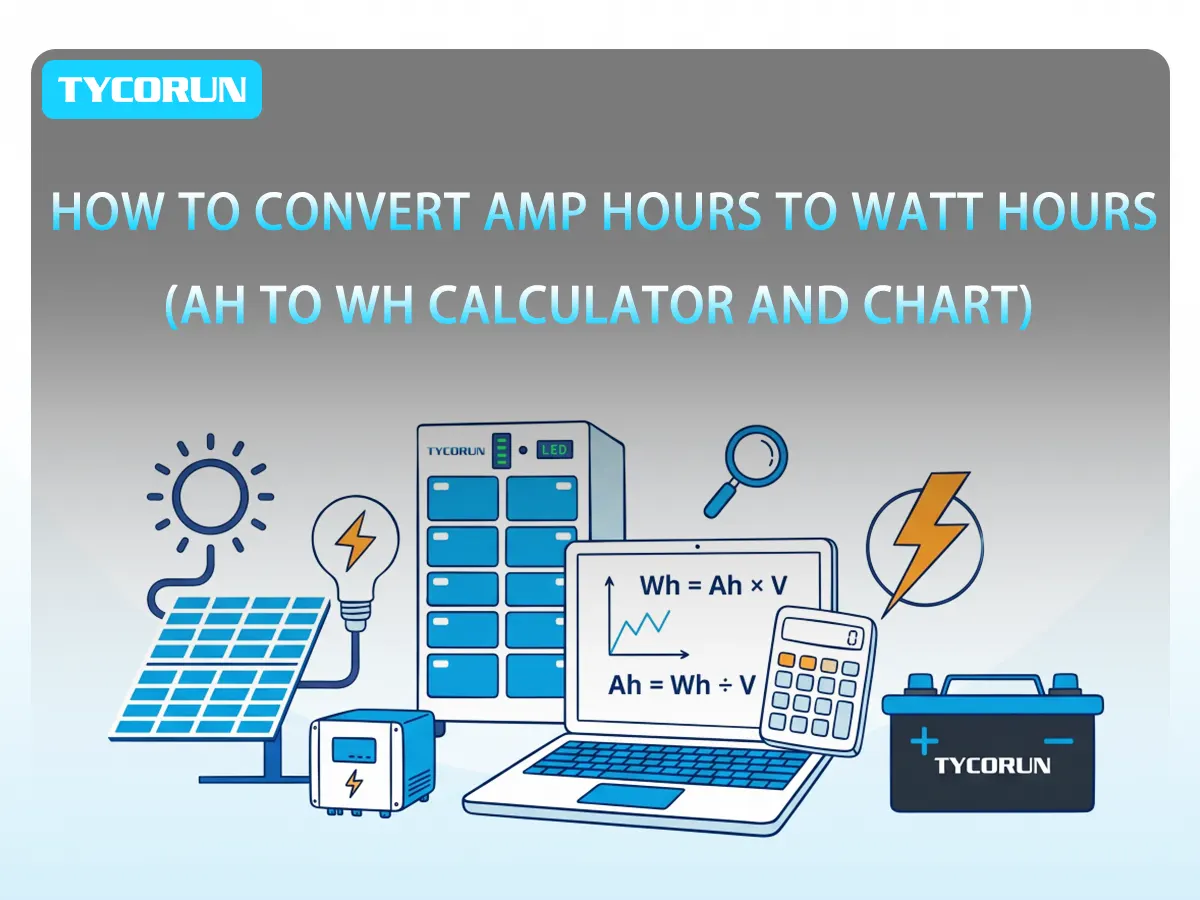
      How to Convert Amp Hours to Watt Hours (Ah to Wh Calculator and Chart)

      How to Convert Amp Hours to Watt Hours (Ah to Wh Calculator and Chart)

      Convert amp hours to watt hours with one formula: Wh = Ah × V. This guide gives you a calculator, lookup charts from 12V to ...
      Lithium Battery for RV Off-Grid Sizing and Cold Charging

      Lithium Battery for RV: Off-Grid Sizing and Cold Charging

      Planning an off-grid RV trip or camping in winter? Find out how much battery capacity you need, how to match it to your appliances, and ...
      Ganfeng Begins 588Ah Storage Cell Ramp; 648Ah Planned for 2027

      Ganfeng Ramps 588Ah Storage Cells, 648Ah Due 2027

      Ganfeng LiEnergy has moved its 588Ah storage cell line into production ramp and scheduled a 648Ah cell for 2027. This article converts the new formats ...
      EU Battery Passport 2027 Requirements for LMT and Energy Storage Batteries

      EU Battery Passport 2027: Requirements for LMT and Energy Storage Batteries

      From 18 February 2027, LMT batteries, EV batteries and industrial batteries above 2 kWh need an EU battery passport. See what the record contains, who ...
      EU Battery Regulation 20231542 What Battery Buyers Need to Know

      EU Battery Regulation 2023/1542: What Battery Buyers Need to Know

      A buyer’s breakdown of Regulation (EU) 2023/1542 for e-mobility and stationary storage. Learn how LMT and industrial batteries are classified, what applies from CE marking ...
      Lithium Battery vs Lithium-Ion Battery What’s the Real Difference

      Lithium Battery vs Lithium-Ion Battery: What’s the Real Difference?

      Lithium vs lithium-ion mostly comes down to single-use versus rechargeable. Here is how to read the label, compare voltage and shelf life, and pick the ...