Skip to content


Last Updated on July 29, 2026
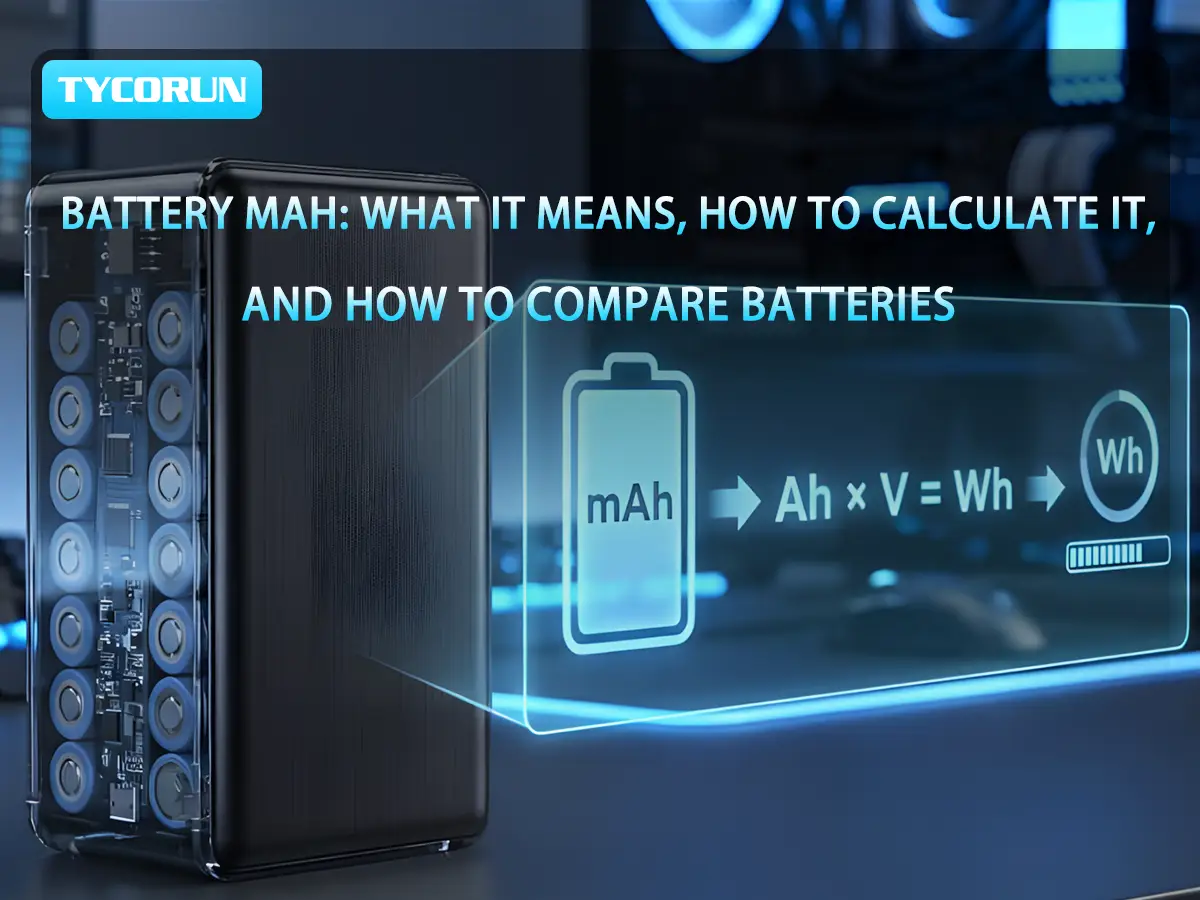
mAh (milliampere-hour) measures a battery’s electrical charge capacity — not its total energy. A higher mAh rating generally means a battery can supply current for longer under comparable conditions, but it doesn’t tell the whole story until you factor in voltage.
Think of mAh as the size of a water tank, and voltage as the water pressure. A smaller tank under higher pressure can do just as much work — or more — than a much larger tank trickling out water slowly.
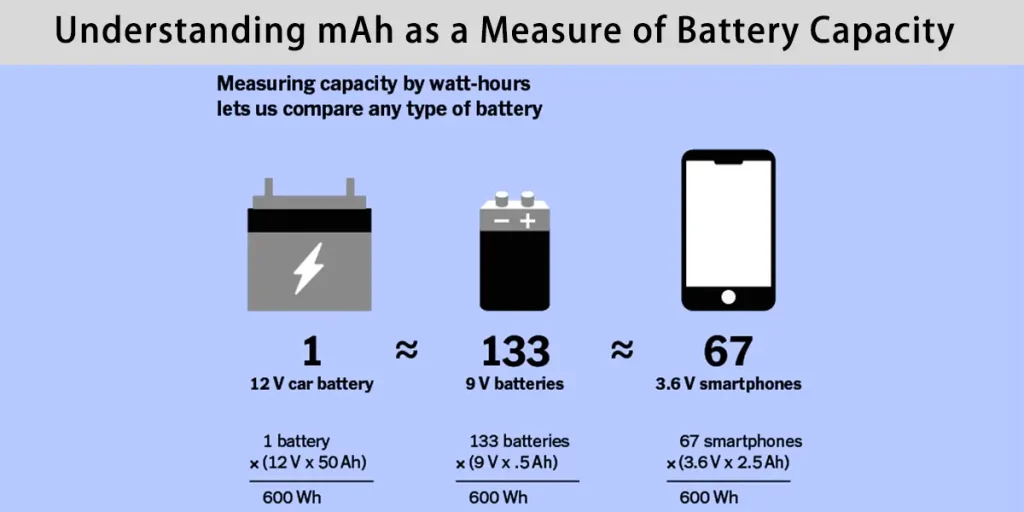
To meaningfully compare batteries, especially when voltages differ, convert mAh into watt-hours (Wh):
Wh = (mAh × V) ÷ 1,000
The key rule: mAh is most useful for comparing batteries with the same nominal voltage and comparable test conditions. When voltage differs, Wh generally gives a more meaningful comparison. This guide walks through what mAh battery capacity means, how to convert it to Ah and Wh, how to estimate runtime, and how to compare batteries the right way.
Key Takeaways:
- mAh is charge, Wh is energy. mAh tells you how much electrical charge a battery holds; voltage determines how much actual energy that charge represents.
- Apples to apples only. Comparing mAh directly only works when batteries share the same voltage and similar test conditions. If voltages differ, compare Wh instead.
- Runtime isn’t just math. Real-world runtime depends on device power demand, usable capacity, and voltage-conversion efficiency — not just the number printed on the label.
- Match voltage first. When replacing a battery, voltage compatibility and physical fit come before capacity. Extra mAh is irrelevant if the battery doesn’t fit or match your system’s voltage.


What Does mAh Mean on a Battery?
mAh stands for milliampere-hour. It measures the amount of electrical charge a battery is rated to deliver over time.
Since 1Ah = 1,000mAh:
- 500mAh = 0.5Ah
- 2,000mAh = 2Ah
- 5,000mAh = 5Ah
- 100Ah = 100,000mAh
In simplified terms, a 5,000mAh battery could theoretically deliver 5,000mA for one hour, or 500mA for ten hours — though the capacity actually delivered depends on the specific test conditions used to rate it.
Is a Higher mAh Battery Always Better?
Not necessarily. A higher mAh rating generally indicates greater charge capacity when batteries are compared under similar voltage and test conditions, but higher capacity often comes with trade-offs:
- Larger size and more weight — more capacity generally requires more internal material.
- Higher cost — higher-capacity cells are typically more expensive.
- Longer charge times — if charging power stays the same, a larger battery generally takes longer to fill.
- Compatibility risk — a higher-mAh battery may be physically too large, or electrically mismatched, for your device.
Most importantly: if two batteries run at different voltages, a higher mAh number does not automatically mean more stored energy.

Why Voltage Matters: mAh vs. Energy (Wh)
Energy content depends on both capacity and voltage:
Energy (Wh) = Voltage (V) × Capacity (Ah)
Here’s how the same 5Ah rating plays out at three different voltages:
| Battery | Nominal Capacity | Nominal Voltage | Nominal Energy |
|---|---|---|---|
| Battery A | 5Ah | 3.7V | 18.5Wh |
| Battery B | 5Ah | 12V | 60Wh |
| Battery C | 5Ah | 51.2V | 256Wh |
All three share the same 5Ah rating, but Battery C holds by far the most energy. This is exactly why comparing mAh alone can be misleading once voltage differs: a 3.7V, 5,000mAh phone battery (18.5Wh) and a 12V, 12Ah e-bike battery (144Wh) can look deceptively close if you only glance at the mAh number — yet the e-bike battery holds nearly eight times the actual energy.
The Power Bank Catch
The same logic applies to power banks. That “10,000mAh” printed on the box is commonly based on the nominal voltage of the internal lithium cell (usually 3.7V). When the power bank steps that up to charge your phone over USB (5V, 9V, or higher), some energy is lost in the conversion. As a result, the energy actually delivered to your device is typically lower than the battery’s nominal rating suggests.
Real-World Relevance: Air Travel
This is also why aviation authorities regulate lithium batteries by Wh, not mAh. The FAA generally permits lithium-ion batteries up to 100Wh in carry-on baggage without approval; spare batteries between 101Wh and 160Wh typically require airline approval; batteries over 160Wh are generally not allowed on passenger aircraft. It’s a good real-world example of Wh — not mAh — being the number that actually matters.
mAh vs. Ah: What's the Difference?
Only the unit scale: 1Ah = 1,000mAh. Manufacturers generally choose whichever unit fits the device category:
- mAh — smaller consumer electronics (phones, earbuds, wearables)
- Ah — vehicle, marine, and larger industrial batteries
- Wh or kWh — comparing total system energy (EVs, home energy storage)

How Do You Calculate Battery Runtime from mAh?
For a simple system where battery and device share the same voltage:
Runtime (hours) ≈ Battery capacity (mAh) ÷ Device current draw (mA)
Example: 5,000mAh ÷ 500mA ≈ 10 hours.
Under a constant 500mA load, a 5,000mAh battery could theoretically run for about 10 hours. Actual runtime is often shorter, since device power demand fluctuates, the full rated capacity isn’t always usable, and voltage-conversion losses reduce the energy that reaches the device.
If the battery and device operate at different voltages, calculating energy in Wh and factoring in conversion efficiency gives a more reliable runtime estimate than comparing mAh directly.
How Do You Convert mAh to Wh?
Wh = (mAh × Voltage) ÷ 1,000
Example: a 5,000mAh battery at 3.7V → (5,000 × 3.7) ÷ 1,000 = 18.5Wh.
You need the voltage to make this conversion — mAh alone can’t tell you the energy content. The result is nominal energy based on stated voltage; usable energy delivered to a device depends on the system and battery conditions.

Why Doesn't a Battery Always Deliver Its Rated mAh?
Rated capacity is measured under specified test conditions (IEC 61960-3:2017 sets out standardized performance and test methods for portable lithium cells and batteries — essentially, the discharge rate, temperature, and cutoff conditions under which a battery’s “rated” mAh is measured). Real-world usable capacity can be higher or lower than that rating, depending on:
- Discharge Rate — Higher discharge rates can reduce the capacity actually available, though the size of the effect depends on chemistry and design. It’s particularly noticeable in lead-acid batteries; many lithium-ion batteries hold onto a greater share of their rated capacity at higher discharge rates, but this still varies by cell design and configuration.
- Temperature — Cold conditions reduce both capacity and power output. Lithium-ion batteries should only be charged within the temperature range the manufacturer specifies.
- Battery Age — Available capacity declines with age and cycling. As a rough reference point, many consumer lithium-ion cells are considered to have reached end-of-usable-life once capacity fades to around 80% of original rating after several hundred charge cycles — though the exact curve depends heavily on chemistry, charge habits, and storage conditions, so treat this as a general reference rather than a guarantee.
- Cutoff Voltage — A device or battery management system (BMS) may stop discharge before all nominal capacity is extracted, to protect the battery and equipment.
Because of these factors, two batteries with identical mAh ratings can deliver different real-world usable energy.
Does Battery Chemistry Affect mAh?
Yes — battery chemistry affects nominal voltage, energy density, thermal behavior, battery life cycle, and discharge performance:
- LiFePO₄ (Lithium Iron Phosphate) — Known for thermal stability and strong cycle life, though it has a lower nominal voltage (around 3.2V) and generally lower energy density, which can mean more weight for the same capacity.
- NMC / NCA (Nickel-based lithium-ion) — Typically offer higher energy density and lighter weight, common in smartphones and many EVs, though often with somewhat shorter cycle life compared to LiFePO₄.
Two batteries with identical mAh ratings can behave very differently depending on the chemistry inside them. For a basic capacity comparison, check voltage and capacity first — chemistry then explains why two batteries with similar specs differ in energy density, discharge performance, thermal safety, and service life.
How Much mAh Do You Need?
Required capacity (mAh) ≈ Device current draw (mA) × Desired runtime (hours)
Example: 1,000mA × 5 hours = 5,000mAh (ideal requirement).
In practice, it’s worth budgeting for some extra capacity beyond this ideal number, since system losses mean the full rated capacity is rarely 100% usable. The right buffer varies by application and battery chemistry, so check manufacturer guidance or your system’s specific efficiency figures rather than relying on a single rule of thumb. For larger battery systems, work in Wh or kWh instead of mAh.
Why Do Large Batteries Use Ah or kWh Instead of mAh?
Same measurement, different unit for practicality:
- Portable battery: 5,000mAh
- Larger lithium battery: 100Ah
- Home energy storage system: 10.24kWh (51.2V × 200Ah = 10,240Wh)
Writing that home storage system’s capacity as “200,000mAh” would be technically correct but impractical — 10.24kWh communicates the scale far more clearly.
How to Compare Batteries Beyond mAh (Checklist)
- Confirm voltage compatibility first with the device or system. Mismatched voltage can damage electronics or cause system failure.
- Compare mAh or Ah when voltage matches and test conditions are comparable — a higher rating generally means more capacity.
- Compare nominal Wh when voltage differs, using Wh = V × Ah, keeping in mind actual usable energy varies with system efficiency.
- Check compatibility specs: continuous/peak current, dimensions, connectors, and charging requirements.
- For long-term use, compare usable capacity, cycle life, operating temperature range, and BMS protection— not just the headline capacity number.

Conclusion
A battery’s mAh rating measures charge capacity — not total energy or runtime. For batteries at the same voltage, higher mAh generally means more capacity. When voltages differ, convert to Wh (Wh = V × Ah) for a meaningful energy comparison, and factor in device power demand and usable capacity to estimate real-world runtime.
Next time you’re shopping for a battery, look past the mAh number on the box. Check the voltage, calculate the watt-hours, and factor in real-world efficiency to get the performance you’re actually paying for.
Frequently Asked Questions
Not automatically. It can mean greater capacity, but it's not automatically better for every application — a higher-mAh battery may be larger, heavier, more expensive, or physically incompatible with your device.
At a constant 500mA load, roughly 10 hours in theory. Actual runtime is often shorter due to fluctuating power demand and voltage-conversion losses.
It depends on voltage. At 3.7V, 5,000mAh is about 18.5Wh — a typical phone-sized battery. At 12V, the same 5,000mAh rating is 60Wh — over three times the energy.
Wh = (mAh × Voltage) ÷ 1,000. Example: a 10,000mAh battery at 3.7V → (10,000 × 3.7) ÷ 1,000 = 37Wh.
Generally, yes, when voltage, load, and efficiency are comparable. It doesn't directly determine service life, though — that depends on chemistry, cycling, charging habits, and temperature.
Only if voltage, physical dimensions, connectors, charging requirements, and discharge capability are all compatible. A higher mAh rating alone doesn't guarantee compatibility.

This article will explore “Can you use a higher Ah battery?” start from understanding Ah mean, the relationship between voltage and capacity, answering can you use a higher ah battery, advantages and disadvantages of using a higher ah battery, real-world examples, and how to choose the right higher ah battery.

How many Ah is a car battery? Most cars use 40Ah–70Ah batteries, while larger vehicles may require 60Ah–100Ah. This guide explains typical car battery capacity, the difference between Ah and CCA, and how to choose the right battery for your car.

In this article, we will discuss more about what is Ah in battery, starting with the definition, its effect on performance, and common misconceptions about Ah, and then how to calculate and select batteries according to the required Ah.
Authors
-
 View all posts
Audrey Chloe is a writer and researcher focused on energy storage technologies, with a particular interest in lithium-ion batteries, battery management systems (BMS), and their real-world use in e-bikes, electric vehicles, and home energy storage. With a background in materials science, she explores how battery chemistry, design, and usage patterns affect performance, safety, and lifespan.
Her goal is to turn complex battery concepts into clear, practical insights that help people make informed decisions about everyday energy technologies.
-
 View all posts
Meg is a battery engineer with 10+ years of experience in the energy storage industry. She holds a B.S. in Electrical Engineering and previously worked as an R&D engineer at a lithium-ion battery manufacturer, where she focused on battery management systems (BMS), charging algorithms, and life-cycle testing for lead-acid, AGM, and lithium chemistries. She has contributed to the development of battery maintenance technologies used in commercial products. Meg now provides technical review for energy storage content to ensure accuracy, safety, and practical value for readers.