Last Updated on July 15, 2026
A battery fuse is a safety device that protects your battery and electrical system from excessive current. When current exceeds a safe level, the fuse melts and breaks the circuit, preventing fires and equipment damage.
Battery fuses are essential in vehicles, solar power systems, energy storage systems (ESS), and electronic devices. This guide covers what a battery fuse does, the different types available, how to size one correctly, and how to replace one safely.
What is Battery Fuse?
A battery fuse is a safety device installed in the positive cable near the battery. It contains a metal element that melts when too much current flows through it, permanently opening the circuit.
A battery fuse protects your electrical system in two ways:
- Overload protection — When a device draws more current than the circuit is designed for (a shorted wire, a faulty component), the fuse heats up and melts, cutting off the flow of electricity.
- Short-circuit protection — If the positive and negative wires touch directly, the battery can dump thousands of amps in a fraction of a second. The fuse must break this massive current before the wire overheats and starts a fire.
The golden rule: A fuse protects the wire, not the device. The fuse rating must always be lower than the wire’s maximum safe current (ampacity), but higher than the device’s normal operating current.
Working Principle of Battery Fuse
Inside every fuse is a metal element designed to melt at a specific temperature. Here’s what happens during an overcurrent event:
- Normal operation — Current flows through the fuse element without issue.
- Overcurrent event — Excess current heats the element beyond its melting point.
- Circuit interruption — The element melts, creating a gap that stops current flow.
- Arc quenching — In DC systems (like batteries), the fuse must also extinguish the electrical arc that forms when the circuit breaks. High-quality fuses use sand or ceramic filler to absorb this energy.
Why DC fuses are different: AC current naturally crosses zero 50–60 times per second, which makes arcs easier to break. DC current is continuous, so DC fuses need stronger arc-quenching designs. Never use an AC-rated fuse in a DC battery circuit.
Types of Battery Fuses
| Fuse Type | Current Range | AIC Rating | Best For | Mounting |
|---|---|---|---|---|
| Blade (ATC/ATO) | 1–40 A | ~1,000 A | Cars, small electronics, branch circuits | Plug-in fuse box |
| Mini / Micro Blade | 1–30 A | ~1,000 A | Modern vehicles, space-constrained circuits | Plug-in |
| Cartridge Fuse | 1–60 A | 1,500–3,000 A | Industrial equipment, appliances | Holder or panel |
| ANL Fuse | 35–750 A | 2,700–6,000 A | Car audio, solar, inverters | Bolt-on holder |
| MEGA Fuse | 100–500 A | ~2,000 A | Heavy vehicles, marine, large inverters | Bolt-on holder |
| MIDI Fuse | 30–200 A | ~2,000 A | Medium power, battery distribution | Bolt or clip |
| MRBF (Terminal Fuse) | 30–300 A | ~10,000 A @ 14V DC | Single LiFePO4 batteries, clean installs | Bolts to battery post |
| Class T Fuse | 1–1,200 A | ~20,000 A @ 125V DC | LiFePO4 banks, ESS, marine, EV | Separate holder |
Quick type guide
- Blade fuses (ATC/ATO, Mini, Micro) — the most common type in vehicles. Color-coded by amperage for easy identification. Replace by pulling with fuse pullers. Best for low-current branch circuits.
- ANL fuse — metal plate with bolt holes at each end. Handles large currents (up to 750 A) and is popular in car audio, solar, and inverter installations.
- MEGA fuse — designed for very high currents (up to 500 A). Used in heavy vehicles, ships, and large electrical systems.
- MIDI fuse — similar to MEGA but smaller. Ideal for medium-power protection in vehicles and battery systems.
- MRBF fuse — mounts directly on the battery terminal post, giving the cleanest installation for a single LiFePO4 battery.
- Class T fuse — the standard choice for larger lithium battery banks. Its high AIC rating is why most marine and RV lithium installs converge on it once a bank exceeds a couple hundred amp-hours (more on the AIC math below).
Fuse classes like ANL, MEGA, MIDI, and Class T aren’t just marketing names — each corresponds to a specific construction and testing standard under UL 248, the family of standards governing low-voltage fuses in North America. Buying a fuse listed to the correct UL 248 part for its class is what ensures the AIC rating printed on the fuse body is actually verified, not just claimed by the manufacturer.
Battery Fuse Sizing Guide: How to Choose the Right Fuse
Step 1 — Calculate your load current
Fuse Rating (A) = Device Power (W) ÷ System Voltage (V) × 1.25
Example: A 2,000 W inverter on a 12V system → 2,000 ÷ 12 = 166.7 A → 166.7 × 1.25 = 208 A → round up to the next standard size (225 A or 250 A).
For motor loads (pumps, compressors, winches), use a 1.5–2.0× multiplier to handle startup surge.
Step 2 — Check wire ampacity
Your fuse rating must never exceed 80% of the wire’s ampacity.
| Fuse Type | Current Range | AIC Rating | Best For | Mounting |
|---|---|---|---|---|
| Blade (ATC/ATO) | 1–40 A | ~1,000 A | Cars, small electronics, branch circuits | Plug-in fuse box |
| Mini / Micro Blade | 1–30 A | ~1,000 A | Modern vehicles, space-constrained circuits | Plug-in |
| Cartridge Fuse | 1–60 A | 1,500–3,000 A | Industrial equipment, appliances | Holder or panel |
| ANL Fuse | 35–750 A | 2,700–6,000 A | Car audio, solar, inverters | Bolt-on holder |
| MEGA Fuse | 100–500 A | ~2,000 A | Heavy vehicles, marine, large inverters | Bolt-on holder |
| MIDI Fuse | 30–200 A | ~2,000 A | Medium power, battery distribution | Bolt or clip |
| MRBF (Terminal Fuse) | 30–300 A | ~10,000 A @ 14V DC | Single LiFePO4 batteries, clean installs | Bolts to battery post |
| Class T Fuse | 1–1,200 A | ~20,000 A @ 125V DC | LiFePO4 banks, ESS, marine, EV | Separate holder |
Example: If your calculation says 250 A but your wire is only 2 AWG (130 A ampacity), you have a mismatch — upgrade the wire or reduce the load before you go any further.
Step 3 — Check AIC (interrupting capacity)
This is where most DIY installs go wrong. AIC is the maximum short-circuit current the fuse can safely break — not just the current it carries in normal operation.
| Battery Type | Typical Short-Circuit Current | Minimum AIC Needed |
|---|---|---|
| Small lead-acid (≤100 Ah) | 1,000–3,000 A | 1,500–3,000 A |
| Large lead-acid / AGM | 3,000–6,000 A | 5,000 A |
| Single LiFePO4 (100–200 Ah) | 5,000–10,000 A | 10,000 A (MRBF) |
| Parallel LiFePO4 bank | 10,000–20,000+ A | 20,000 A (Class T) |
| Large ESS / EV battery pack | 50,000–200,000 A | 100,000+ A (specialized) |
Critical rule: Never substitute a higher-rated fuse than what’s specified, and never reuse a MEGA or ANL fuse from an old lead-acid system on a lithium battery. Lithium batteries can dump current so fast that an under-rated fuse may vaporize before it fully opens the circuit — effectively welding shut and failing to protect the wiring. If a correctly-sized fuse keeps blowing, there’s an underlying problem (short circuit, overload, or wrong device) — find and fix the root cause instead of upsizing.
Step 4 — Choose fuse type
- Single 12V LiFePO4, 100–200 Ah, land-based → MRBF
- Two or more LiFePO4 batteries in parallel, or 24V/48V systems → Class T
- Marine installations → Class T(verify against the current edition of ABYC E-11/E-13, which is periodically revised)
- Car audio, solar inverter, lead-acid battery → ANL or MEGA
- Vehicle branch circuits → Blade (ATC/ATO/Mini)
- Industrial / commercial → Cartridge or Class T
Step 5 — Placement
Install the fuse as close as practical to the battery’s positive terminal. Within 7 inches (18 cm) of the terminal is the widely cited marine-industry benchmark (ABYC), and it’s good practice for land-based systems too — most standards allow a longer run only if the cable is protected in a sheath or conduit. Every positive cable leaving the battery needs its own fuse.
Battery Fuse Sizing by Application
Car battery fuse
Most vehicles use blade fuses (ATC/ATO) in a fuse box near the battery. Common ratings: main battery fuse 80–150 A (protects the alternator and main feed); starter circuit often unfused (high inrush current); branch circuits 5–30 A (lights, radio, ECU, etc.). Blown-fuse symptoms include a car that won’t start, flickering dashboard lights, or a specific electrical feature that stops working.
Solar battery fuse
Solar systems need fuses in three locations: between the solar panels and the charge controller (protects against panel short circuits); between the charge controller and the battery (protects the battery from controller failure); and a battery main fuse (protects the whole system from a battery short). For a typical 12V setup with a 2,000 W inverter: panel fuse 15–30 A, controller-to-battery fuse 60–100 A, battery main fuse 200–300 A Class T or ANL.
LiFePO4 battery fuse
Lithium iron phosphate batteries are now standard in RVs, boats, and off-grid systems, and their fusing requirements differ meaningfully from lead-acid. As a general benchmark referenced by marine lithium standards, budget roughly 5,000 A of AIC for every 100 Ah of LiFePO4 capacity at 12V — a 200 Ah bank typically needs 10,000 A AIC minimum, which rules out standard automotive fuses.
Recommended configuration for a 200 Ah, 12V LiFePO4 bank:
- Main battery protection: a 200 A MRBF on the terminal (~10,000 A AIC) or a 200 A Class T (~20,000 A AIC)
- A separate inverter-feed fuse sized to the inverter’s wattage
- MIDI or blade fuses for branch circuits at the distribution panel
For parallel banks (2 or more batteries), use an MRBF on each battery terminal plus a Class T main fuse after the parallel join — this limits the short-circuit current any single fuse has to interrupt.
Always confirm the current requirements in the latest edition of ABYC E-11/E-13 (or the equivalent standard in your region) before finalizing a marine or safety-critical installation. These standards are revised periodically — most recently with more detailed, capacity-scaled AIC tables — so treat the figures above as planning guidance and check the published standard for your exact bank size.
Causes of Battery Fuse Failures and How to Fix Them
| Cause | What Happens | How to Fix |
|---|---|---|
| Short circuit | Positive wire touches ground or the negative wire, causing a massive current spike | Find and repair the short; inspect wire insulation |
| Overload | Device draws more current than rated (faulty motor, too many devices) | Reduce the load or upgrade the circuit; check device specs |
| Wrong fuse size | Fuse rated too close to normal current, causing nuisance blows | Recalculate using the 125% rule; consider a slow-blow fuse for motors |
| Corroded connections | Resistance at terminals causes localized heating, melting the fuse | Clean terminals with a wire brush; apply dielectric grease |
| Aged fuse | Fuses degrade over time, especially in high-heat environments | Replace the fuse; check for an underlying heat source |
| Inrush current | Motors and inverters draw 3–6× normal current at startup | Use a slow-blow fuse or size at 150–200% of running current |
How to Replace a Battery Fuse
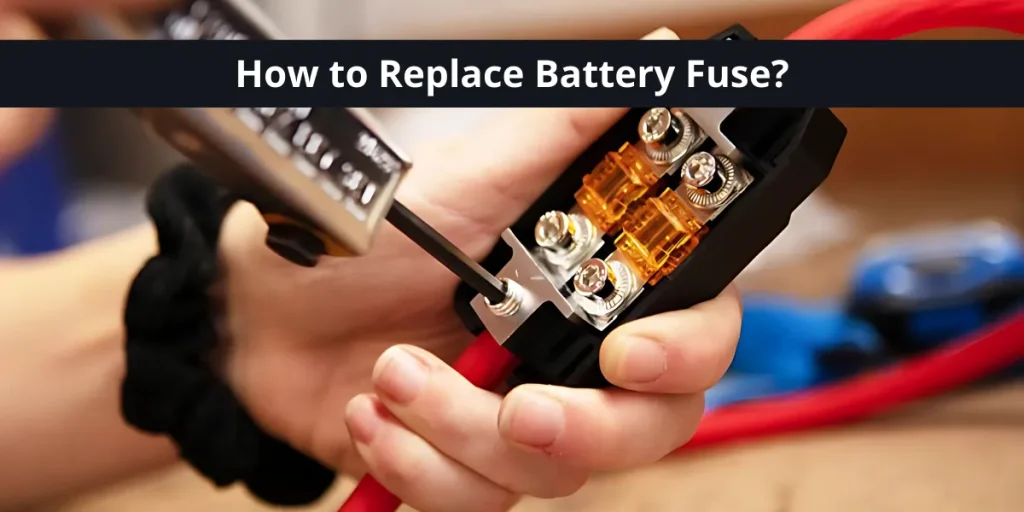
What you’ll need: The correct replacement fuse (same type and rating), a multimeter, an insulated wrench set, safety glasses and gloves, a wire brush, and dielectric grease.
- Turn off power. Disconnect the battery’s negative terminal first — this prevents accidental shorts while you work on the positive side.
- Locate the fuse. Typically in the fuse box near the battery (vehicles), on the battery terminal post (MRBF type), or in a fuse holder near the battery’s positive cable (solar/ESS).
- Test the circuit. Use a multimeter to check voltage on both sides of the fuse holder. If one side has voltage and the other doesn’t, the fuse is blown.
- Remove the old fuse. Blade fuse: pull straight out with fuse pullers. ANL/MEGA/MIDI: remove the bolts with an insulated wrench and lift out the fuse. MRBF: remove the terminal nut and lift off the fuse. Class T: open the holder and remove the fuse.
- Inspect the holder. Check for corrosion, melting, or damage. Clean terminals with a wire brush and apply dielectric grease to prevent future corrosion.
- Install the new fuse. Use the exact same rating and type — never substitute a different type or a higher rating.
- Reconnect and test. Reconnect the battery negative terminal, turn systems on one by one, and verify normal operation. Check for heat at the fuse holder after about 10 minutes.
Battery Fuse vs. Circuit Breaker: Which Is Better?
| Feature | Fuse | Circuit Breaker |
|---|---|---|
| Cost | $1–$30 | $15–$100+ |
| Reset | Must replace | Resettable |
| Speed | Faster response | Slightly slower |
| AIC rating | Higher available (Class T: ~20,000 A) | Lower typical (6,000–10,000 A) |
| Maintenance | None | May need periodic testing |
| Best for | Battery main protection, permanent installs | Branch circuits, frequent access needed |
Recommendation: Use a fuse at the battery, where you want the highest AIC and fastest response, and use breakers downstream for branch circuits that need frequent switching.
Frequently Asked Questions
It breaks the circuit when current exceeds a safe level, preventing wire overheating, fires, and equipment damage caused by short circuits or overloads.
The circuit opens permanently and power stops flowing to everything downstream of it. Replace it with one of the exact same rating and type — don't just swap in whatever's on hand.
No. A fuse that keeps blowing is telling you there's an underlying problem — a short circuit, overload, or wrong device for the circuit. Sizing up risks fire and equipment damage; find and fix the root cause instead.
Calculate Device Power (W) ÷ Voltage (V) × 1.25 to get the fuse rating, then confirm it doesn't exceed 80% of your wire's ampacity. For lithium batteries, also check the AIC rating against your bank's short-circuit current.
DC fuses are built to handle continuous current and stronger arcs, since DC doesn't cross zero the way AC does. Never use an AC-rated fuse in a DC battery circuit.
No. Fuses go on the positive cable only. The negative cable is already grounded, so a fuse there adds no protection.
A 200 A MRBF (roughly 10,000 A AIC) for a single-battery install, or a 200 A Class T (roughly 20,000 A AIC) if you plan to add parallel batteries later. Mount it as close as practical to the battery's positive terminal.
No. A BMS protects individual cells from overcharge and over-discharge, but it may not interrupt a hard short quickly enough. An independent, correctly AIC-rated fuse is still required.
Key Takeaways
- A battery fuse protects the wire, not the device.
- Lithium batteries need higher AIC ratings than lead-acid — don’t reuse old fuses from a lead-acid setup.
- Size your fuse at 125% of continuous load, but never exceed 80% of wire ampacity.
- Class T fuses are the standard choice for larger lithium battery banks; MRBF works well for single, smaller LiFePO4 batteries.
- Mount fuses as close as practical to the battery’s positive terminal.
- Never substitute a higher-rated fuse — find and fix the root cause instead.
TYCORUN Energy manufactures lithium-ion batteries, LiFePO4 battery packs, and energy storage systems for automotive, marine, solar, RV, and industrial applications. Proper fuse protection is critical to battery safety and longevity — this guide is meant to help you select the right fuse for your setup.

This article will explore what is a motorcycle battery fuse, its types, its location, the signs of a blown motorcycle battery fuse, common causes of fuse failure, how to check and replace, and tips to prevent motorcycle battery fuse problems.

An inverter circuit breaker is a safety device designed to automatically stop the electrical flow when it detects an overload, short circuit, or other faults. This helps protect the inverter, connected devices, and your home wiring from damage.

Identify battery positive and negative terminals by symbol, color, and size. Includes safe connection order, reverse polarity consequences, and voltage data for lead-acid, Li-ion, and NiMH.
Authors
-
View all posts
Anastasia is a dedicated renewable energy researcher and technical writer specializing in inverters, home energy storage solutions, and clean energy trends. With a sharp eye for market analysis and industry shifts, she transforms complex technical concepts into actionable, easy-to-understand insights. Her goal is to empower homeowners and businesses alike to make highly informed decisions regarding sustainable energy deployment.
-
View all posts
Meg is a battery engineer with 10+ years of experience in the energy storage industry. She holds a B.S. in Electrical Engineering and previously worked as an R&D engineer at a lithium-ion battery manufacturer, where she focused on battery management systems (BMS), charging algorithms, and life-cycle testing for lead-acid, AGM, and lithium chemistries. She has contributed to the development of battery maintenance technologies used in commercial products. Meg now provides technical review for energy storage content to ensure accuracy, safety, and practical value for readers.