
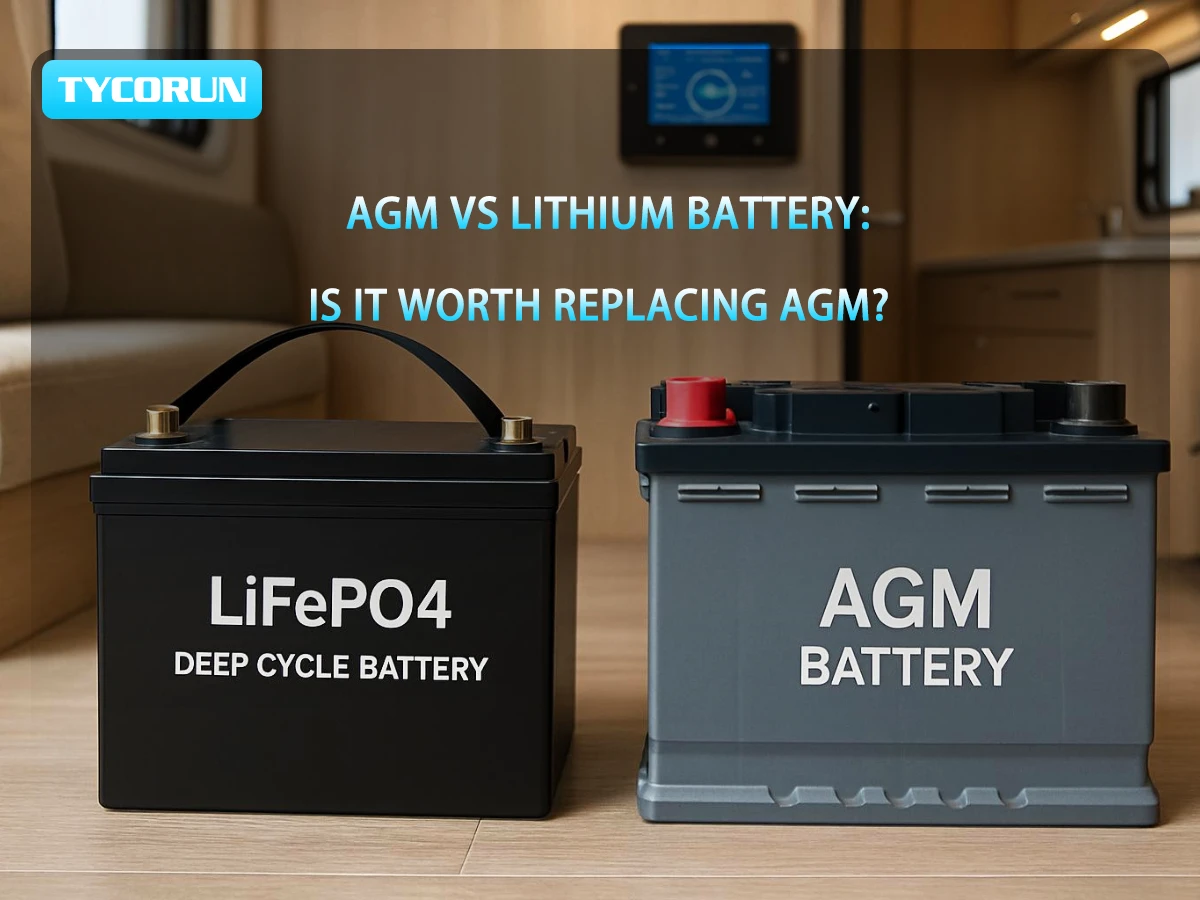

For frequent cycling and long-term use, replacing AGM with lithium is worthwhile. Lithium can offer faster charging, higher usable capacity, lower weight, and longer cycle life. AGM can still make sense when the existing system is already configured for AGM and minimizing the initial replacement cost is the priority.
Replacing AGM with lithium requires more than matching the Ah rating. Check the system voltage, charger, current requirements, physical fit, and connected equipment before buying the replacement.
This guide compares AGM and lithium using real product specifications, walks through the compatibility checks you need before replacing AGM, and helps you decide when switching makes sense.
Key Takeaways:
- Choose lithium for frequent cycling, higher usable capacity, lower weight, and long-term value.
- Choose AGM when lower upfront cost, infrequent cycling, or compatibility with an existing AGM system is the priority.
- An AGM-to-lithium swap is not automatically drop-in — check voltage, charger, current, physical fit, and connected equipment first.
- Compare total value over the battery’s expected service life, not purchase price alone.
AGM vs Lithium: What’s the Difference?
AGM (Absorbent Glass Mat) is a sealed lead-acid battery that uses a glass-mat separator to hold the electrolyte in place. Lithium batteries use lithium-ion chemistry, and LiFePO₄ is the chemistry most commonly used in deep-cycle applications. The two technologies differ most in usable capacity, cycle life, weight, and charging behavior — differences that matter more for deep-cycle use than the Ah number on the label.
A Note on the Comparison Below
The table below pairs Victron Energy’s published AGM specifications (90Ah) with TYCORUN’s own 12V 100Ah LiFePOâ‚„ specifications. We use our own product here because we can verify every figure directly from our published spec sheet — but that also means the lithium side of this table is a single-brand example, not an industry average. AGM and lithium products both vary by manufacturer, so treat the numbers below as one real-world reference pair, not a universal AGM-vs-lithium benchmark. If you’re evaluating a different brand on either side, confirm the equivalent figures against that manufacturer’s own datasheet before comparing costs or performance.
AGM vs Lithium Battery Comparison
| Factor | AGM (Victron Energy 90Ah) | Lithium (TYCORUN 12V 100Ah LiFePOâ‚„) |
|---|---|---|
| Chemistry | Lead-acid (AGM) | LiFePOâ‚„ |
| Nominal capacity | 90Ah | 100Ah |
| Nominal voltage | 12V | 12.8V |
| Usable/nominal energy | 540Wh usable at 50% DoD, 25°C | 1,280Wh nominal energy |
| Cycle life | 600 cycles at 50% DoD, 25°C | >4,000 cycles at 100% DoD, 0.2C, 70% EOL |
| Weight | 27 kg | ~ 12.5kg |
| Charge current | Product-specific | 20A standard / 100A max |
| Maximum continuous discharge | Product-specific | 150A |
| Self-discharge | <2%/month at 20°C | ≤3.5%/month at 25°C |
Cycle life, usable energy, and charging figures vary with DoD, temperature, C-rate, and end-of-life criteria — always confirm against the specific model’s datasheet.
Which Differences Matter Most in Practice?
Usable capacity, not just nominal Ah. In Victron’s own comparison, a 60Ah LiFePOâ‚„ battery delivered more usable energy (614Wh at 80% DoD) than a 90Ah AGM battery (540Wh at 50% DoD) — despite the smaller Ah rating. Compare batteries using the manufacturer’s stated DoD and test conditions, not the Ah number alone.
Cycle life depends on the test conditions. TYCORUN’s 100Ah LiFePOâ‚„ is rated for >4,000 cycles at 100% DoD; the Victron AGM example is rated for 600 cycles at 50% DoD. Because the DoD differs, these numbers aren’t a direct one-to-one comparison — they reflect how each chemistry is typically tested, not identical stress conditions.
Weight. The LiFePO₄ example (~12.5 kg) is roughly half the weight of the AGM example (27 kg) — relevant for RVs, marine use, and anywhere weight or space is constrained.
Charging behavior differs by chemistry, not just by brand. AGM charges in three stages — bulk, absorption, float — with temperature-compensated voltage. LiFePOâ‚„ has a flatter voltage curve, so voltage isn’t read the same way, and temperature compensation is typically disabled.
| Charging parameter | AGM (typical) | LiFePOâ‚„ (Victron 12.8V example) | LiFePOâ‚„ (TYCORUN 12V 100Ah) |
|---|---|---|---|
| Charging stages | Bulk → Absorption → Float | Bulk → Absorption (~2 hrs) → Float | CC (0.2C) → CV |
| Absorption/target voltage | Temperature-compensated | 14.2V absorption / 13.5V float | 14.6V ±0.2V |
| Temp. compensation | Enabled | Disabled | N/A — operate 0–45°C |
The takeaway: don’t assume an AGM charger works for lithium just because the nominal voltage matches. Confirm the charging profile before swapping.
Illustrative Scenario: RV House Battery Upgrade
An RV owner replacing an AGM house battery with a 12V 100Ah LiFePOâ‚„ battery gains roughly 1,280Wh of nominal energy at about half the weight of a comparable AGM battery — relevant for anyone cycling the battery regularly for lighting, refrigeration, and electronics. Before installing, confirm the battery’s 20A standard / 150A max current ratings match the RV’s charging equipment and loads, and check physical dimensions and terminal configuration — this is not automatically a drop-in swap.
Is Lithium Worth the Higher Upfront Cost?
Purchase price alone doesn’t determine value. Compare price against usable energy delivered over the battery’s rated cycle life:
Cost per usable kWh = Purchase price ÷ (Usable energy per cycle × Rated cycle life)
Using the cited AGM example: €239 ÷ (0.540 kWh × 600 cycles) = €0.74 per usable kWh.
To evaluate a lithium battery on the same basis, use its actual purchase price with the manufacturer’s usable energy figure (not nominal, unless the manufacturer defines nominal as usable) and its rated cycle life under the stated test conditions — this lets you compare any lithium battery’s cost-per-usable-kWh against the AGM figure above.
This formula compares purchase cost to rated energy throughput — it excludes calendar life, replacement frequency, and other system costs, so treat it as a starting point rather than a full lifecycle-cost analysis.
Can You Replace an AGM Battery With Lithium?
Compatibility Checklist
Yes, in many systems — but run through this check before you buy:
- Voltage — Match the lithium battery’s voltage to your system’s required voltage.
- Charger — Confirm your charger supports a lithium-specific charging profile; don’t assume an AGM profile carries over.
- Current requirements — Check the battery’s continuous and peak current ratings against your equipment’s demands.
- BMS — Lithium batteries rely on a battery management system to protect the cells; confirm its current limits suit your application (IEC 62619:2022 covers safety requirements for industrial/stationary lithium cells).
- Physical fit — Measure length, width, height, terminal position, polarity, and connector type.
- Connected equipment — Confirm your inverter, motor controller, or charger is rated for the replacement battery’s voltage and operating range.
- Temperature limits — Check minimum charging temperature; most LiFePO₄ batteries restrict charging below a set threshold unless protected or heated.
A battery can pass every electrical check and still fail as a replacement if it doesn’t physically fit — check dimensions and terminals early, not last.
When AGM Is Still the Better Choice
- Upfront cost is the priority
- Cycling is infrequent (occasional backup use)
- The existing charging system is already built for AGM
When Lithium Is the Better Choice
- The battery cycles frequently
- Lower weight or smaller footprint matters (RV, marine, portable)
- Charging flexibility and longer service life offset the higher purchase price
Frequently Asked Questions
For frequent cycling and long-term use, yes — lithium typically offers more usable capacity, longer cycle life, and less weight. For occasional, low-cycle use, AGM's lower upfront cost can make it the more practical choice.
In most systems, yes, but it's not always a drop-in swap. Confirm voltage, charger compatibility, current ratings, physical fit, and connected equipment before installing (see the checklist above).
It depends on how the battery is used. Lithium tends to pay off when higher purchase price is offset by more usable energy and a longer rated cycle life over time — use the cost-per-usable-kWh formula above to check your specific case rather than assuming.
Often, yes. LiFePOâ‚„ requires a charging profile different from AGM's bulk/absorption/float stages, and temperature compensation is typically disabled for lithium. Check your charger's specifications against the battery manufacturer's charging requirements before switching.
Generally yes, but the ratings are tested under different conditions (depth of discharge, C-rate, end-of-life threshold), so compare cycle-life numbers only alongside their test conditions, not as raw figures.
Lithium is generally the stronger fit for frequent deep-cycle use because of its higher usable capacity and cycle-life rating at full depth of discharge. AGM remains viable for lighter, infrequent cycling.
Conclusion
For frequent cycling and long-term use, lithium is generally the stronger choice — its usable capacity, cycle life, and weight advantages tend to outweigh the higher upfront cost over time. AGM remains a practical option for occasional use or when minimizing initial cost is the priority.
Before switching, confirm your system’s voltage, charging requirements, current capability, physical fit, and connected equipment are compatible with the replacement battery.
If you’re evaluating an AGM-to-lithium replacement for your application, contact TYCORUN’s technical team for help matching voltage, capacity, current, and charging requirements to a suitable lithium battery.

Lithium motorcycle batteries offer lighter weight and longer lifespan, while lead-acid batteries remain more affordable upfront. This article explains the key differences and helps riders choose the best option for their needs.

Therefore, in this article, we’ll take a deeper dive into the differences between lithium battery vs alkaline, starting with their definitions, key comparisons, and pros & cons to determine when each type of battery technology is best used.

This article will discuss the main differences between AGM battery vs standard battery, their definitions, how to choose them nicely, and help you determine which one best suits your needs. Let’s go deep!
Authors
-
View all posts
Audrey Chloe is a writer and researcher focused on energy storage technologies, with a particular interest in lithium-ion batteries, battery management systems (BMS), and their real-world use in e-bikes, electric vehicles, and home energy storage. With a background in materials science, she explores how battery chemistry, design, and usage patterns affect performance, safety, and lifespan.
Her goal is to turn complex battery concepts into clear, practical insights that help people make informed decisions about everyday energy technologies.
-
View all posts
Meg is a battery engineer with 10+ years of experience in the energy storage industry. She holds a B.S. in Electrical Engineering and previously worked as an R&D engineer at a lithium-ion battery manufacturer, where she focused on battery management systems (BMS), charging algorithms, and life-cycle testing for lead-acid, AGM, and lithium chemistries. She has contributed to the development of battery maintenance technologies used in commercial products. Meg now provides technical review for energy storage content to ensure accuracy, safety, and practical value for readers.





